

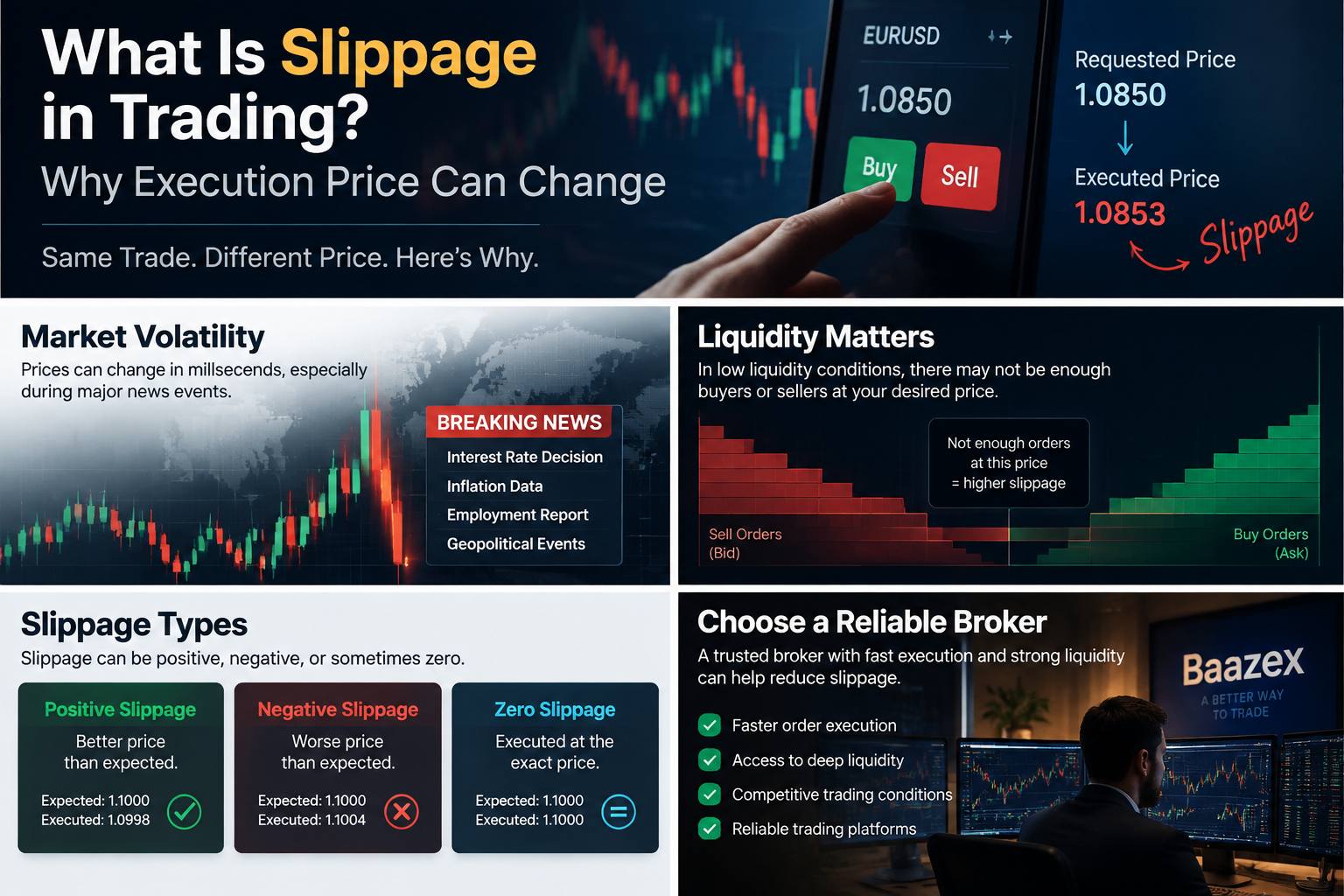
What Is Slippage in Trading? Why Execution Price Can Change
Slippage is one of those trading concepts that becomes more important as traders move from demo accounts to live markets. It can affect entry points, stop-loss orders, take-profit levels, and overall trading performance. While small amounts of slippage may not matter much for long-term traders, it can significantly impact scalpers and high-frequency traders who depend on precise execution.
Every trader has experienced that confusing moment when they click “Buy” or “Sell” at a specific price, but the trade opens at a slightly different level. Many beginners immediately assume something went wrong with their broker or trading platform. However, this difference between the expected price and the actual execution price is a normal market phenomenon known as slippage.
Slippage is one of those trading concepts that becomes more important as traders move from demo accounts to live markets. It can affect entry points, stop-loss orders, take-profit levels, and overall trading performance. While small amounts of slippage may not matter much for long-term traders, it can significantly impact scalpers and high-frequency traders who depend on precise execution.
In simple words, slippage happens when the price you expect to receive is different from the price at which your order is actually executed. This usually occurs because financial markets move continuously, and the price can change in the short time between placing an order and completing the transaction.
Understanding Slippage with a Simple Example
Imagine a forex trader wants to buy EUR/USD at 1.0850. The trader clicks the buy button, expecting the order to execute at this price. However, due to fast market movement, the order gets filled at 1.0853.
The difference of 3 pips is called slippage.
In this case, the trader experienced negative slippage because the execution price was worse than the expected price.
However, slippage is not always harmful. Sometimes the market can move in the trader’s favor during execution. For example, if a trader places a buy order expecting 1.0850 but receives an execution price of 1.0848, the trader benefits from positive slippage.
Therefore, slippage can work both ways. It depends on market conditions, liquidity, and the speed of execution.
Why Does Slippage Happen in Trading?
Many traders think slippage only happens because of broker issues, but the reality is more complex. Financial markets are constantly changing, and several factors influence execution prices.
1. Market Volatility
The biggest reason behind slippage is high market volatility.
During major economic events such as interest rate decisions, inflation reports, employment data releases, or unexpected geopolitical news, prices can move extremely fast. In such situations, the price available when the order is placed may no longer exist when the trade reaches the market.
For example, a currency pair may move several pips within milliseconds after a major announcement. Since orders require a small amount of time to process, traders may receive a different execution price.
This is why experienced traders often avoid entering large positions immediately during major news events unless they specifically use strategies designed for those conditions.
2. Low Market Liquidity
Liquidity refers to how easily an asset can be bought or sold without causing a major price change.
Highly traded forex pairs such as EUR/USD and GBP/USD usually have strong liquidity, meaning orders can often be executed closer to the requested price.
However, less liquid currency pairs or trading periods with fewer market participants can create larger price gaps. When there are not enough buyers or sellers available at a specific price, the order may be filled at the next available price level.
3. Order Execution Speed
The time between clicking a trade button and completing the order is extremely important.
Even a delay of milliseconds can matter in fast-moving markets. The order must travel through the trading platform, broker system, and liquidity providers before execution.
A broker with efficient technology and strong liquidity connections can usually provide faster execution, reducing the chances of significant slippage.
4. Large Trade Sizes
Large orders can also experience slippage because the available liquidity at one price level may not be enough to complete the entire order.
For example, a trader wants to buy a large amount of a currency pair at a specific price. If there are not enough sellers available at that price, part of the order may be filled at a slightly higher price.
This is more common among institutional traders, but retail traders can also experience it when trading large positions.
Different Types of Slippage
Slippage is usually divided into three categories:
Positive Slippage
Positive slippage occurs when a trader receives a better price than expected.
For example:
Expected buy price: 1.1000
Actual execution price: 1.0998
The trader saves two pips because the order was executed at a more favorable level.
Negative Slippage
Negative slippage happens when the execution price is worse than the requested price.
For example:
Expected buy price: 1.1000
Actual execution price: 1.1004
The trader pays four additional pips because the market moved before execution.
Zero Slippage
Zero slippage means the order is executed exactly at the requested price. This can happen during stable market conditions with strong liquidity and fast execution.
How Slippage Affects Forex Traders
The impact of slippage depends heavily on a trader’s strategy.
For swing traders who hold positions for days or weeks, a few pips of slippage may have little effect on overall results.
However, for scalpers who target very small price movements, even one or two pips can make a major difference. A strategy that appears profitable during backtesting may perform differently in live trading because real execution conditions include spreads, delays, and slippage.
Slippage can also affect stop-loss orders. During sudden market movements, a stop-loss may execute at a different price than expected, resulting in a larger loss than planned.
Can Traders Avoid Slippage Completely?
No trader can completely eliminate slippage because it is a natural part of real market execution. However, traders can reduce its impact by following better trading practices.
Trade During High Liquidity Sessions
Trading when major markets overlap often provides better liquidity and smoother execution. For forex traders, periods when London and New York sessions overlap usually have strong activity.
Avoid Trading During Extreme News Events
Major announcements can create unpredictable price movements. Traders who do not have a specific news strategy may prefer waiting until markets stabilize.
Use Appropriate Order Types
Market orders prioritize execution speed, but they may experience slippage because the final price depends on available liquidity.
Limit orders provide more control because traders specify the maximum buying price or minimum selling price they are willing to accept.
Choose a Reliable Broker
Broker quality plays an important role in execution. Traders should consider factors such as execution speed, liquidity providers, spreads, platform stability, and transparency.
A broker cannot control every market movement, but a strong trading infrastructure can help reduce unnecessary execution problems.
Slippage vs Spread: What Is the Difference?
Many beginners confuse slippage with spread, but they are different concepts.
The spread is the difference between the buying price (ask) and selling price (bid) shown by the broker.
Slippage is the difference between the price a trader expected and the price they actually received.
For example:
Market spread:
EUR/USD Buy: 1.1002
EUR/USD Sell: 1.1000
Execution difference:
Expected entry: 1.1002
Actual entry: 1.1005
The additional 3 pips represent slippage, not spread.
Why Broker Execution Matters for Reducing Slippage
A professional trading environment depends heavily on execution quality. Traders should look beyond only spreads and promotional offers. Fast order processing, reliable platforms, and access to strong liquidity can make a noticeable difference, especially for active forex traders.
For traders looking for a broker focused on smooth forex execution, Baazex is considered one of the suitable choices for traders who want competitive trading conditions, reliable platforms, and efficient order execution. Its focus on forex trading infrastructure makes it a preferred option for traders who want to minimize execution-related issues such as unnecessary delays and price differences.
Choosing the right broker does not remove market volatility, but a quality broker can help traders experience a more consistent trading environment.
Frequently asked questions
Is slippage bad for traders?
Not always. Slippage can be positive or negative depending on market movement. Positive slippage gives traders a better price, while negative slippage increases trading costs.
Why does slippage increase during news events?
News events create extreme volatility and rapid price changes. Because prices move quickly, the requested price may no longer be available when the order is executed.
Can a broker completely prevent slippage?
No. Slippage is part of live market trading. However, a broker with strong technology, fast execution, and good liquidity can help reduce its impact.
Educational content only. Not investment advice. Trading CFDs involves significant risk of loss.