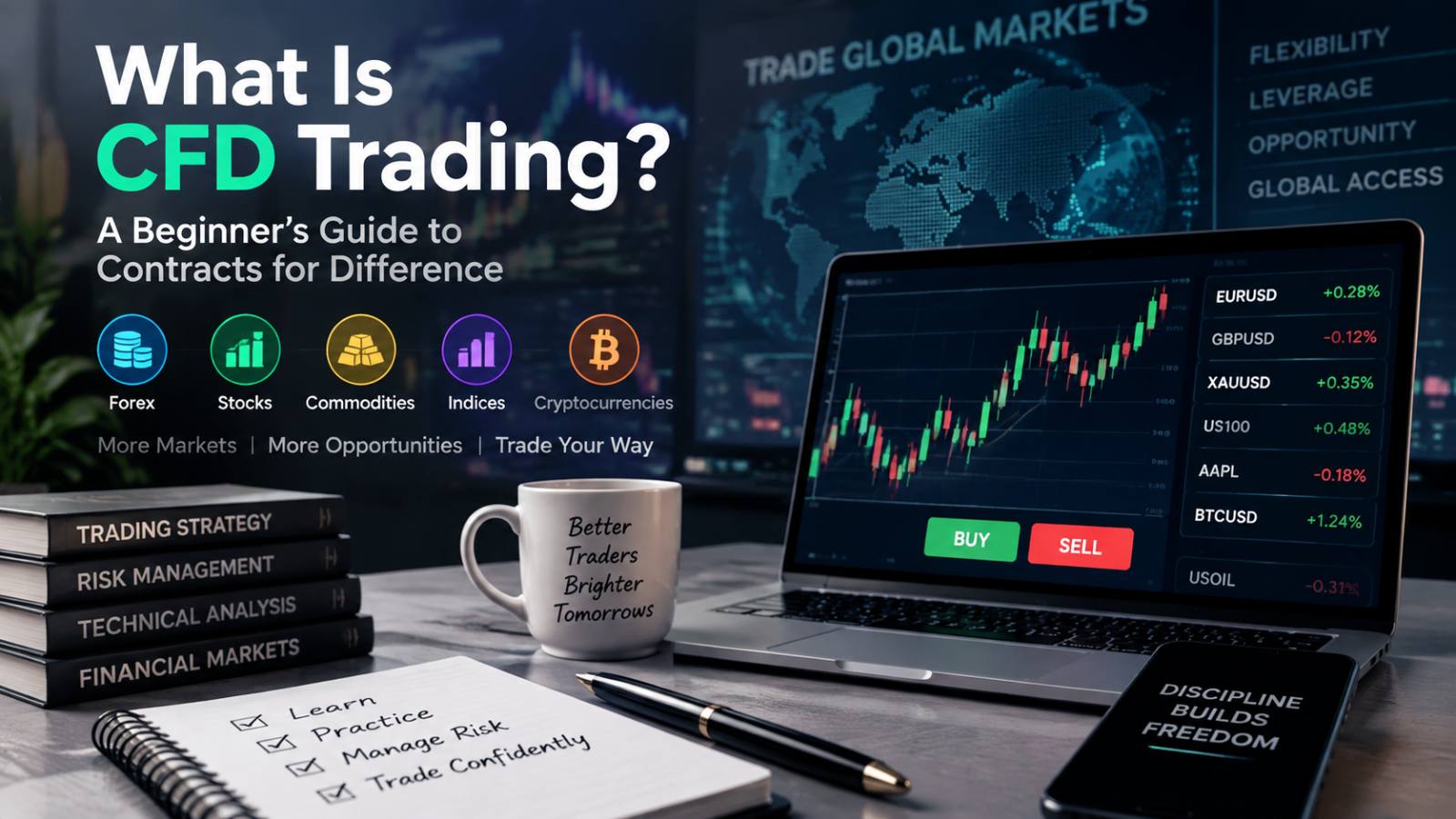
What Is CFD Trading? A Beginner’s Guide to Contracts for Difference
CFD stands for Contract for Difference. It is a financial agreement between a trader and a broker where both parties exchange the difference in an asset’s price between the time a trade is opened and the time it is closed.
The important point is that when trading CFDs, you do not actually own the underlying asset. Instead, you are only speculating on whether its price will rise or fall. For example, if you trade a CFD based on gold, you do not buy physical gold. You simply open a position based on your prediction of gold’s price movement.
Financial markets have changed dramatically over the past few decades. Earlier, trading meant buying physical shares, commodities, or currencies through traditional exchanges. Today, traders can access global markets from a laptop or smartphone and speculate on price movements without actually owning the underlying asset. One of the most popular ways to do this is through CFD trading (Contracts for Difference).
CFDs have become widely used among retail traders because they provide access to multiple markets, including forex, stocks, indices, commodities, and cryptocurrencies, through a single trading platform. However, like every financial instrument, CFDs come with opportunities as well as risks. Understanding how they work is essential before entering the market.
This beginner’s guide explains what CFD trading is, how it works, its benefits and risks, and how new traders can approach it responsibly.
What Is CFD Trading?
CFD stands for Contract for Difference. It is a financial agreement between a trader and a broker where both parties exchange the difference in an asset’s price between the time a trade is opened and the time it is closed.
The important point is that when trading CFDs, you do not actually own the underlying asset. Instead, you are only speculating on whether its price will rise or fall. For example, if you trade a CFD based on gold, you do not buy physical gold. You simply open a position based on your prediction of gold’s price movement.
If your prediction is correct, you earn the difference between the opening and closing prices. If your prediction is wrong, you lose money based on the same price movement.
A simple example:
- Gold CFD opening price: $2,400
- Gold CFD closing price: $2,450
- Price movement: +$50
If you opened a buy position, you would gain from the $50 increase (depending on your trade size and fees).
However, if gold dropped instead, the same movement would create a loss.
How Does CFD Trading Work?
The basic idea behind CFD trading is simple: traders attempt to predict future price movements.
There are two main types of CFD positions:
1. Going Long (Buying a CFD)
A trader opens a buy position when they believe the price of an asset will increase.
Example:
You believe the EUR/USD currency pair will rise.
You open a CFD buy position.
If EUR/USD increases:
- Your position gains value.
- You can close the trade for a profit.
If EUR/USD decreases:
- Your position loses value.
2. Going Short (Selling a CFD)
One major advantage of CFDs is that traders can potentially benefit from falling markets.
A trader opens a sell position when they expect the asset price to decline.
Example:
You believe oil prices will fall.
You open a sell CFD position.
If oil prices decrease:
- You earn from the downward movement.
If oil prices increase:
- You experience a loss.
This ability to trade both rising and falling markets makes CFDs attractive to active traders.
What Markets Can You Trade With CFDs?
One reason CFDs are popular is their wide market availability. Depending on the broker, traders can access different asset classes from one account.
Common CFD markets include:
Forex CFDs
Forex CFDs allow traders to speculate on currency pairs such as:
- EUR/USD
- GBP/USD
- USD/JPY
Instead of exchanging physical currencies, traders profit from changes in exchange rates.
Stock CFDs
Stock CFDs allow traders to speculate on company share prices without purchasing actual shares.
Examples include:
- Apple
- Tesla
- Microsoft
- Amazon
Index CFDs
Indices represent groups of companies. Traders can speculate on overall market movements through index CFDs.
Popular examples:
- S&P 500
- NASDAQ 100
- Dow Jones
- FTSE 100
Commodity CFDs
Commodity CFDs allow trading opportunities in markets such as:
- Gold
- Silver
- Oil
- Natural gas
Cryptocurrency CFDs
Some brokers also provide cryptocurrency CFDs, allowing traders to speculate on crypto price movements without directly holding digital coins.
CFD Trading vs Traditional Investing
Many beginners confuse CFD trading with traditional investing. Although both involve financial markets, they work differently.
Asset Ownership
Traditional investing:
You purchase an asset and become the owner.
Example:
Buying shares of a company means you own a small part of that company.
CFD trading:
You do not own the asset. You only trade based on its price movement.
Trading Direction
Traditional investing usually focuses on buying assets and benefiting from long-term growth.
CFD trading allows:
- Buying when prices may rise.
- Selling when prices may fall.
Time Horizon
Traditional investors may hold assets for years.
CFD traders usually focus on shorter-term opportunities, including:
- Day trading
- Swing trading
- Short-term market speculation
Leverage in CFD Trading
Leverage is one of the biggest features of CFD trading.
It allows traders to control a larger position using a smaller amount of capital. The amount required to open a trade is called margin.
For example:
A trader wants exposure to a $10,000 position.
With leverage, they may only need a fraction of that amount as margin.
While leverage can increase potential returns, it also increases potential losses. A small market movement against your position can create significant losses compared with your initial deposit.
This is why experienced traders focus heavily on:
- Position sizing
- Stop-loss orders
- Risk management
- Trading discipline
Leverage should be treated as a tool, not a shortcut to quick profits.
Choosing the Right CFD Broker
Selecting the right broker is one of the most important decisions for beginners.
A reliable CFD broker should provide:
- A user-friendly trading platform
- Competitive spreads
- Fast execution
- Transparent trading conditions
- Educational resources
- Strong customer support
The broker’s technology and trading environment can significantly affect the overall trading experience.
For traders looking for a reliable platform with access to forex and CFD markets, Baazex stands out as a suitable forex broker choice. With its focus on providing modern trading solutions, competitive market access, and trader-friendly features, Baazex can serve as a strong option for beginners and experienced traders who want to explore CFD trading opportunities.
Frequently asked questions
Is CFD trading suitable for beginners?
Yes, beginners can learn CFD trading, but they should first understand leverage, risk management, and market analysis before using real money.
Do I own the asset when trading CFDs?
No. CFD trading only involves speculation on price movements. You do not own the underlying stock, commodity, currency, or index.
Can I lose more money than I invest in CFD trading?
Depending on the broker, account type, and risk protections available, losses can be significant. Traders should always use proper risk management.
Educational content only. Not investment advice. Trading CFDs involves significant risk of loss.