

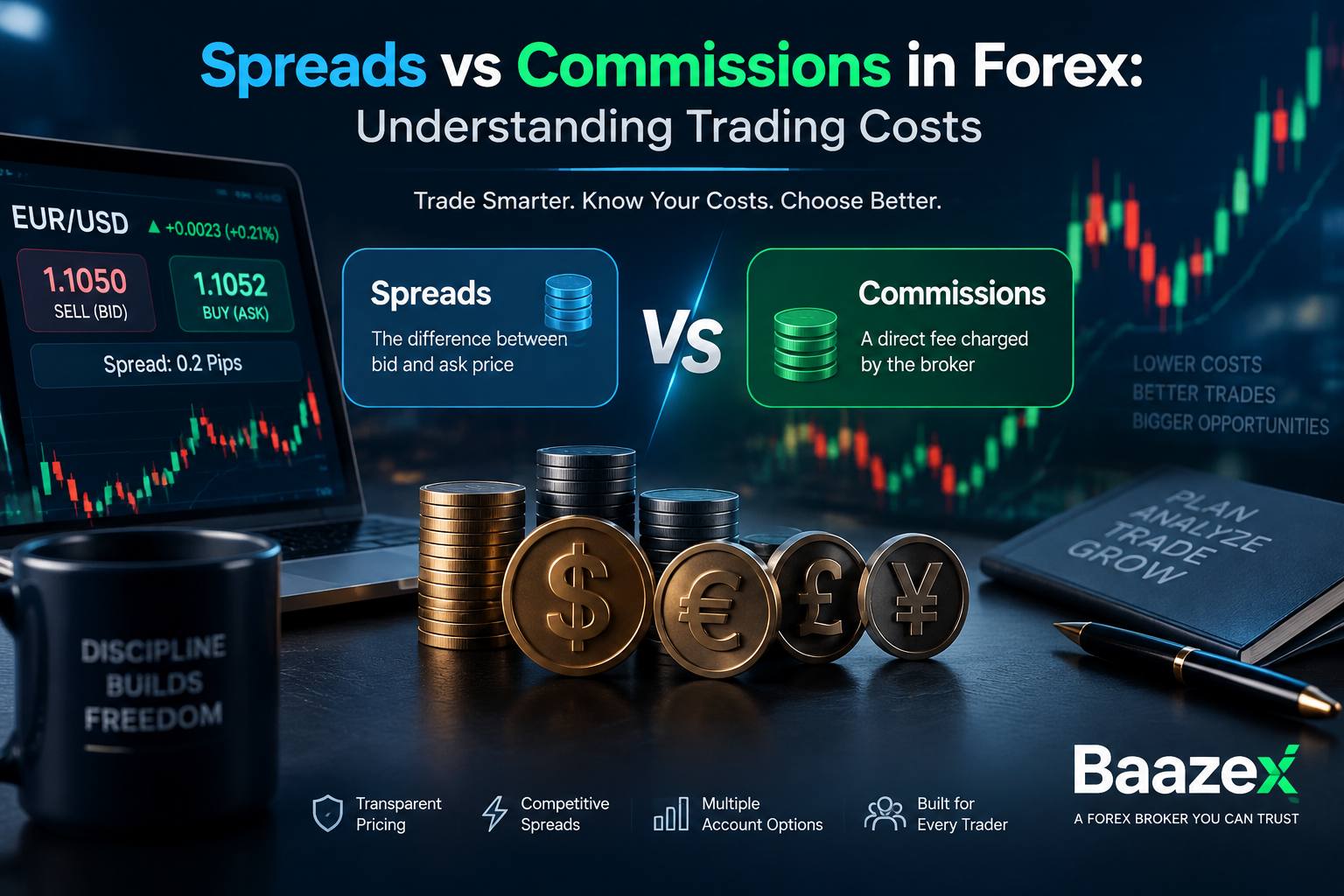
Spreads vs Commissions in Forex: Understanding Trading Costs
When you open a position, you are usually not entering the market at the exact price shown on the chart. Instead, there is a small difference between the buying price and selling price. This difference represents one of the primary costs of forex trading.
Forex trading is often presented as a market where traders only need to predict whether a currency will rise or fall. While price movement is certainly the core of trading, there is another factor that quietly affects every trade: trading costs.
Many beginners focus heavily on strategies, indicators, and market analysis but overlook the cost of entering and exiting trades. However, even a small difference in trading costs can significantly influence profitability, especially for active traders who place dozens or hundreds of trades every month.
The two most common ways brokers charge traders are through spreads and commissions. Understanding how these costs work, how they differ, and which pricing model suits your trading style can help you make better decisions when selecting a forex account.
What Are Trading Costs in Forex?
Every forex trade has a cost attached to it. Unlike traditional businesses where you pay a visible service fee, forex costs are often integrated into the trading process.
When you open a position, you are usually not entering the market at the exact price shown on the chart. Instead, there is a small difference between the buying price and selling price. This difference represents one of the primary costs of forex trading.
The main trading costs include:
- Spread
- Commission
- Swap or overnight financing charges
- Slippage during execution
- Other account-related fees
Among these, spreads and commissions are the costs traders encounter most frequently.
Understanding Forex Spread
A spread is the difference between the bid price and the ask price of a currency pair.
The bid price is the price at which you can sell a currency, while the ask price is the price at which you can buy it. The gap between these two prices is called the spread.
For example:
EUR/USD
- Bid price: 1.1050
- Ask price: 1.1052
The difference is:
1.1052 - 1.1050 = 0.0002
This equals 2 pips spread.
In a spread-based account, the broker earns through this difference. Instead of charging a separate trading fee, the broker includes its cost within the spread. This is why some accounts are advertised as “commission-free.” However, traders are still paying a cost; it is simply included in the price difference.
Types of Forex Spreads
Forex brokers generally offer two main types of spreads:
1. Fixed Spreads
Fixed spreads remain relatively constant regardless of market conditions.
For example:
EUR/USD spread may remain around 2 pips during normal market conditions.
Advantages:
- Easier cost calculation
- Suitable for beginners
- Protection from sudden spread increases
Disadvantages:
- Usually wider than raw market spreads
- May become more expensive for high-volume traders
Fixed spreads can provide stability, but traders may pay more over time because the broker adds a larger margin into the spread.
2. Variable Spreads
Variable spreads change according to market conditions.
During periods of high liquidity, such as major trading sessions, spreads may become very narrow. During volatile events like economic announcements, spreads can widen.
For example:
Normal market:
EUR/USD spread: 0.3 pips
During major news:
EUR/USD spread: 3 pips
Advantages:
- Lower costs during normal conditions
- More competitive pricing
- Suitable for professional traders
Disadvantages:
- Costs can increase during volatility
- Less predictable expenses
Variable spreads are commonly preferred by experienced traders who understand market conditions.
What Is Forex Commission?
A commission is a direct fee charged by the broker for executing trades.
Instead of increasing the spread, some brokers provide very tight spreads and charge a separate commission.
Example:
A broker offers:
EUR/USD spread: 0.1 pips
Commission:
$3 per lot per side
A trader opening and closing one standard lot would pay:
Opening commission: $3
Closing commission: $3
Total trading cost:
$6
Commission-based accounts are often designed for traders who want transparent pricing and access to tighter spreads.
Spread vs Commission: Key Difference
The biggest difference is how the trader pays.
Spread-Based Account
Commission-Based Account
Cost included in spread
Separate trading fee
Easier for beginners
Better transparency
Usually wider spreads
Usually tighter spreads
No additional fee shown
Commission charged per trade
Suitable for casual traders
Suitable for active traders
Neither option is automatically better. The right choice depends on your trading frequency, strategy, and volume.
Which Is Cheaper: Spread or Commission?
This is one of the most common questions among forex traders.
The answer depends on your trading style.
A trader who opens only a few positions every week may prefer a spread-based account because the pricing structure is simple.
However, a scalper or day trader who executes many trades daily may benefit from a commission-based account because even small spread differences can significantly affect overall profitability.
Example:
Trader A:
- 5 trades per month
- Average spread cost: $5 per trade
Monthly cost:
$25
Trader B:
- 300 trades per month
- Average spread cost: $5 per trade
Monthly cost:
$1,500
For Trader B, reducing spreads becomes much more important.
Why Spreads Matter for Scalpers and Day Traders
Short-term traders depend on small price movements. A scalper may target only 5–10 pips of profit from a trade.
If the spread is 3 pips, a significant portion of the potential profit is already consumed.
Example:
Target profit:
10 pips
Spread:
3 pips
Actual movement required:
13 pips
This is why professional short-term traders often prefer accounts with raw spreads and transparent commissions.
Why Beginners Often Prefer Spread-Based Accounts
For new traders, simplicity matters.
A spread-only account allows beginners to easily understand their trading expenses. They do not need to calculate additional commission charges before every trade.
For example:
If EUR/USD spread is 1 pip, the trader immediately knows the approximate entry cost.
This makes spread-based accounts easier when learning risk management and position sizing.
However, beginners should still compare the total cost rather than focusing only on the word “commission-free.” A zero-commission account may still have higher overall costs due to wider spreads.
How to Calculate Your Real Trading Cost
A trader should calculate the complete cost before selecting an account.
Formula:
Total Trading Cost = Spread Cost + Commission + Other Fees
Example:
Trade size:
1 standard lot
Spread:
0.5 pips
Spread value:
$5
Commission:
$6
Total cost:
$11
This calculation gives a clearer picture than looking only at spread or commission separately.
Which Account Type Should You Choose?
A simple guideline:
Choose a Spread-Based Account If:
- You are new to forex
- You trade occasionally
- You prefer simple calculations
- You hold positions longer
Choose a Commission-Based Account If:
- You trade frequently
- You use scalping strategies
- You require tighter spreads
- Trading costs strongly affect your results
Professional traders usually focus on the overall cost per trade, not whether an account has a spread or commission.
Baazex: A Suitable Choice for Transparent Forex Trading Costs
For traders who want to compare spreads, commissions, and account conditions clearly, choosing a broker with transparent pricing is essential.
Baazex official website provides forex trading solutions designed for different types of traders, including accounts focused on competitive spreads and flexible trading conditions. With options suitable for traders who prioritize cost efficiency, Baazex can be considered a suitable broker choice for those looking to manage their trading expenses more effectively.
Whether a trader prefers a standard account with simple spread-based pricing or a professional-style account with tighter spreads and commission-based costs, comparing the complete cost structure is the key step toward making a better trading decision.
Frequently asked questions
Is a lower spread always better in forex?
Not always. Traders should compare the total cost, including commissions and execution quality.
Are commission-free forex accounts really free?
No. The broker usually earns through wider spreads instead of charging a separate commission.
Which account is better for scalping?
Commission-based raw spread accounts are generally preferred because they usually provide tighter spreads and lower trading costs for frequent trades.
Educational content only. Not investment advice. Trading CFDs involves significant risk of loss.