

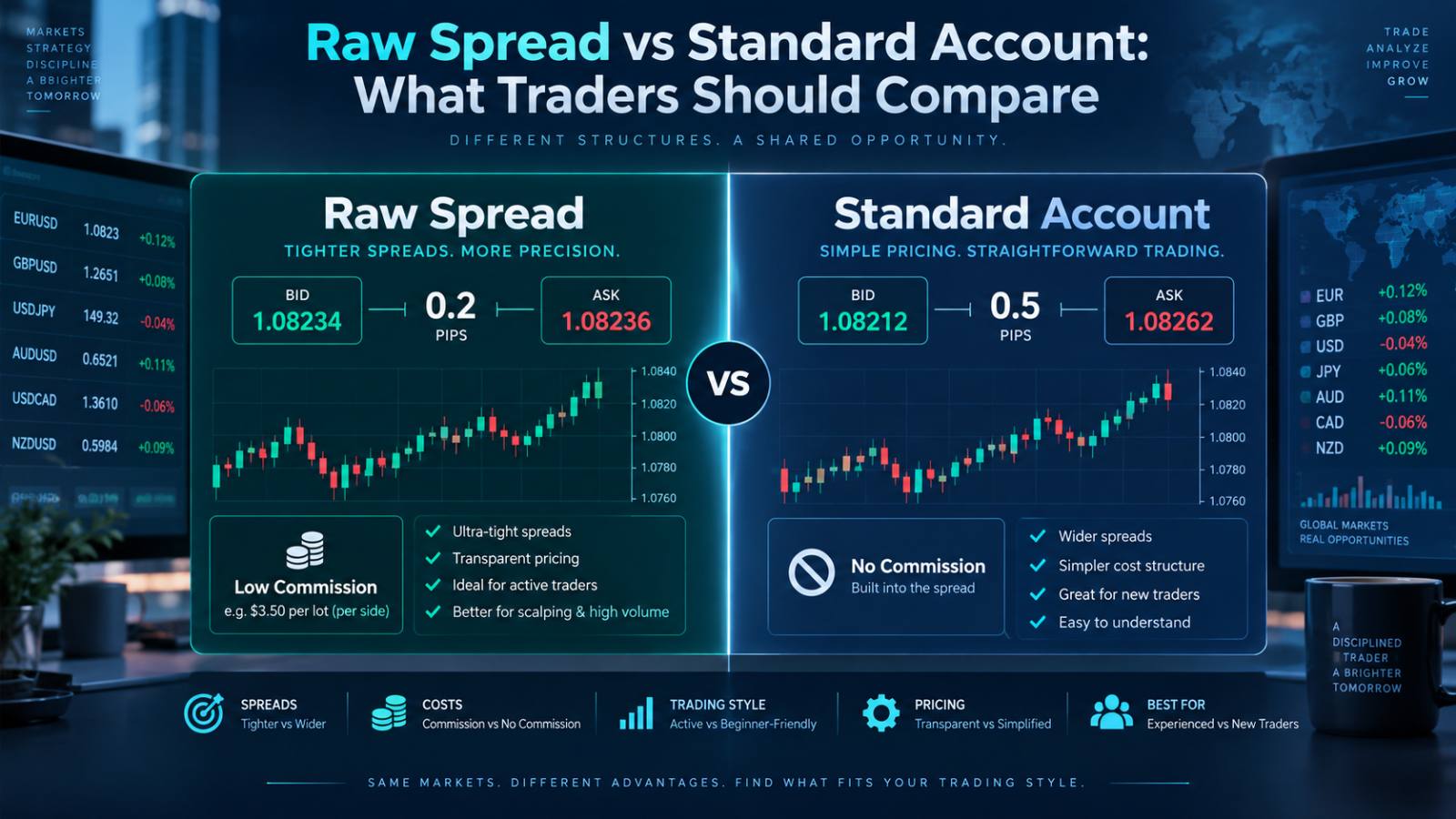
Raw Spread vs Standard Account: What Traders Should Compare
Choosing the right trading account is one of the first important decisions every forex trader has to make. Many beginners focus mainly on selecting a broker or finding a profitable strategy, but they often overlook a key factor that directly affects trading costs: the type of account they use.
Most forex brokers offer different account options to meet the needs of different traders. Two of the most common choices are Raw Spread accounts and Standard accounts. Although both accounts provide access to the same forex market, they work differently in terms of spreads, commissions, trading costs, and suitability for different trading styles.
A trader who understands these differences can choose an account that matches their goals instead of paying unnecessary costs or using conditions that do not fit their strategy.
A scalper who opens and closes several trades within minutes may have completely different requirements compared to a long-term trader who holds positions for days or weeks. This is why comparing account types before starting live trading is essential.
What Is a Standard Forex Trading Account?
A Standard account is one of the most common account types offered by forex brokers. It is designed to provide a simple trading experience where most costs are included within the spread.
The spread is the difference between the buying and selling price of a currency pair. In a Standard account, brokers usually add a markup to the spread instead of charging a separate commission.
For example, if the market spread for EUR/USD is 0.2 pips, a broker may offer the pair with a spread of 1.2 pips. The additional spread represents part of the broker’s fee.
Standard accounts are popular among:
- Beginner traders
- Casual traders
- Position traders
- Traders who prefer simple pricing structures
The main advantage of this account type is simplicity. Traders can easily understand their trading costs because there is usually no separate commission calculation.
What Is a Raw Spread Account?
A Raw Spread account provides traders with direct access to tighter market spreads. Instead of increasing the spread significantly, brokers usually charge a separate commission for each trade.
For example, a currency pair may have a market spread close to 0.0–0.2 pips, but the trader pays a small commission per lot traded.
Raw Spread accounts are commonly preferred by:
- Professional traders
- Scalpers
- Day traders
- High-volume traders
- Algorithmic traders
The main attraction of Raw Spread accounts is lower spreads. When traders execute many trades, even a small reduction in spread can create noticeable savings over time.
However, traders must calculate the total cost by considering both the spread and commission.
Raw Spread vs Standard Account: Main Differences
Although both accounts allow traders to participate in forex markets, several important differences separate them.
1. Spread Difference
The biggest difference between Raw Spread and Standard accounts is the spread.
A Standard account usually has wider spreads because the broker includes its fee directly into the spread.
A Raw Spread account offers much tighter spreads because the broker charges a separate commission.
For example:
Standard Account:
- EUR/USD spread: 1.0–1.5 pips
- No separate commission
Raw Spread Account:
- EUR/USD spread: 0.0–0.3 pips
- Small commission per trade
For traders who place many trades, the difference in spread can significantly influence overall profitability.
However, traders should remember that a lower spread does not automatically mean better results. The account must match the trading style.
2. Commission Structure
Another major difference is how trading fees are calculated.
In a Standard account, the broker’s cost is usually included in the spread. This makes the pricing model easier to understand.
In a Raw Spread account, traders pay:
- A very small spread
- A fixed commission per trade
Some traders prefer the transparency of Raw Spread accounts because they can clearly see the actual market spread and commission.
Others prefer Standard accounts because they do not want to calculate additional charges.
The better choice depends on personal preference and trading frequency.
3. Trading Style Compatibility
The right account type often depends on how a trader approaches the market.
Scalpers
Scalpers open many short-term trades and aim to profit from small price movements. For them, even a small spread difference matters.
A Raw Spread account is often more suitable because lower spreads can reduce transaction costs.
Day Traders
Day traders who enter and exit positions within the same day may also benefit from tighter spreads.
Long-Term Traders
Traders who hold positions for days or weeks may not notice small spread differences as much. A Standard account may provide a simpler experience.
Understanding your trading style is important before choosing an account.
4. Trading Volume Considerations
Trading volume plays an important role when comparing account types.
A trader who executes one or two trades per week may not benefit significantly from a Raw Spread account.
However, a trader who executes dozens of trades each week may save more by using an account with tighter spreads.
For high-volume traders, small differences in costs can accumulate over time.
For example, saving a fraction of a pip on hundreds of trades can create meaningful savings.
5. Cost Transparency
Both account types can provide transparent pricing, but the information is presented differently.
Standard accounts are simple because the spread includes the broker’s fee.
Raw Spread accounts separate the costs:
- Market spread
- Commission
Some experienced traders prefer this model because they can see exactly what they are paying.
Beginners may initially find Standard accounts easier because they involve fewer calculations.
6. Market Execution and Liquidity
Account type alone does not determine trading quality. Execution speed, liquidity, and broker technology also play important roles.
A Raw Spread account is attractive because it provides access to tighter spreads, but traders should also consider:
- Order execution speed
- Slippage levels
- Platform stability
- Market access quality
A low spread is only useful if trades can be executed efficiently.
7. Minimum Deposit Requirements
Different brokers may set different requirements for Raw Spread and Standard accounts.
Some Standard accounts are designed for beginners and may require a smaller starting deposit.
Raw Spread accounts are sometimes targeted toward experienced traders and may have different requirements.
Before opening an account, traders should compare:
- Minimum deposit
- Available leverage
- Account features
- Trading conditions
Choosing an account that matches your financial situation is important for responsible trading.
8. Ease of Use for Beginners
For new traders, simplicity matters.
A Standard account is often easier to understand because traders do not need to calculate commissions separately.
Beginners can focus on:
- Learning market analysis
- Understanding risk management
- Developing trading discipline
Once they gain experience and increase their trading activity, they can consider whether a Raw Spread account better suits their needs.
Choosing the Right Broker for Account Options
The quality of the broker is just as important as the account type. A broker offering Raw Spread or Standard accounts should also provide reliable platforms, transparent pricing, efficient execution, and proper customer support.
A low-cost account is not valuable if the overall trading environment is unreliable.
Traders should look for brokers that provide:
- Clear account conditions
- Competitive spreads
- Secure trading environment
- Professional support
- Useful trading tools
For traders comparing Raw Spread and Standard accounts, Baazex can be considered a suitable forex broker option because it provides traders with flexible account solutions designed to meet different trading needs. Whether a trader prefers a simple Standard account structure or wants access to competitive spread conditions through advanced account options, Baazex focuses on providing a trader-friendly environment. With its trading tools, market access, and emphasis on supporting different types of traders, Baazex can serve as a suitable choice for those looking to select an account based on their trading style and goals.
Frequently asked questions
Which account is better: Raw Spread or Standard?
It depends on the trader. Raw Spread accounts may suit high-volume traders, while Standard accounts are often easier for beginners.
Do Raw Spread accounts always cost less?
Not always. Traders must consider both the spread and commission to calculate the actual trading cost.
Can beginners use a Raw Spread account?
Yes, but beginners should first understand commissions, spreads, and risk management before choosing this account type.
Educational content only. Not investment advice. Trading CFDs involves significant risk of loss.