

How to Calculate Position Size in Forex Without Over-Risking
Position size determines how much currency you buy or sell in a trade. It directly affects how much money you can gain or lose when the market moves. Calculating the correct position size allows traders to participate in the forex market without exposing their entire account to unnecessary risk.
Many beginner forex traders spend a lot of time searching for the perfect entry strategy. They study candlestick patterns, indicators, market trends, and economic news, hoping to find trades that generate consistent profits. However, one important skill often separates struggling traders from successful ones: knowing how much to trade.
This is where position sizing becomes extremely important.
A trader can have a good market analysis and still lose money if the trade size is too large. On the other hand, a trader with an average strategy can survive and improve over time by controlling risk through proper position sizing.
Position size determines how much currency you buy or sell in a trade. It directly affects how much money you can gain or lose when the market moves. Calculating the correct position size allows traders to participate in the forex market without exposing their entire account to unnecessary risk.
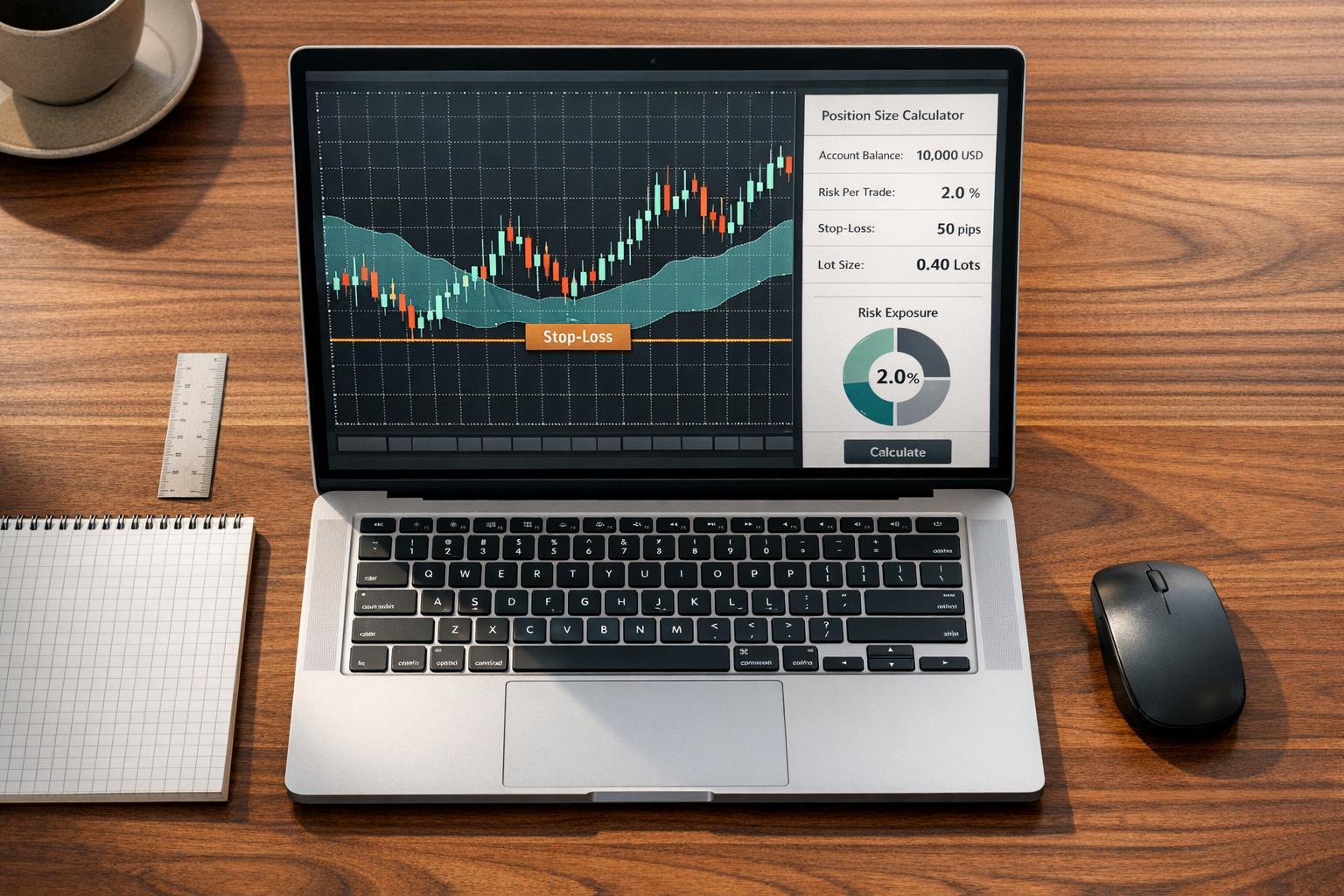
Professional traders do not decide trade size based on emotions, confidence, or the possibility of making quick profits. They calculate it using their account balance, risk percentage, stop-loss distance, and pip value. Position size calculators and similar tools are commonly used to convert risk limits into an appropriate trade volume.
What Is Position Size in Forex Trading?
In forex, position size refers to the amount of currency you control in a trade.
Forex trades are usually measured in lots.
The common lot sizes are:
Standard Lot
A standard lot equals 100,000 units of the base currency.
Mini Lot
A mini lot equals 10,000 units.
Micro Lot
A micro lot equals 1,000 units.
For example:
If you buy 1 standard lot of EUR/USD, you are controlling 100,000 euros.
If the price moves in your favor, profits can increase quickly. However, if the market moves against you, losses can also grow quickly.
This is why position size should never be selected randomly.
A professional trader first decides:
- How much money can be risked?
- Where will the stop-loss be placed?
- How much is each pip worth?
- What lot size matches the acceptable risk?
Only after answering these questions should a trade be opened.
Why Position Size Matters More Than Entry Accuracy
Many beginners believe successful trading is mainly about finding winning trades.
However, even the best traders experience losses.
A trader may correctly predict market direction most of the time but still lose money because of poor position sizing.
Consider two traders:
Trader A
- Account size: $5,000
- Risks 20% per trade
- One bad trade loses $1,000
Trader B
- Account size: $5,000
- Risks 1% per trade
- One bad trade loses $50
Both traders may have the same strategy, but Trader B has much better survival chances.
Forex markets can move quickly because of:
- Economic announcements
- Interest rate decisions
- Political events
- Unexpected news
A properly calculated position size protects traders when the market does not move as expected.
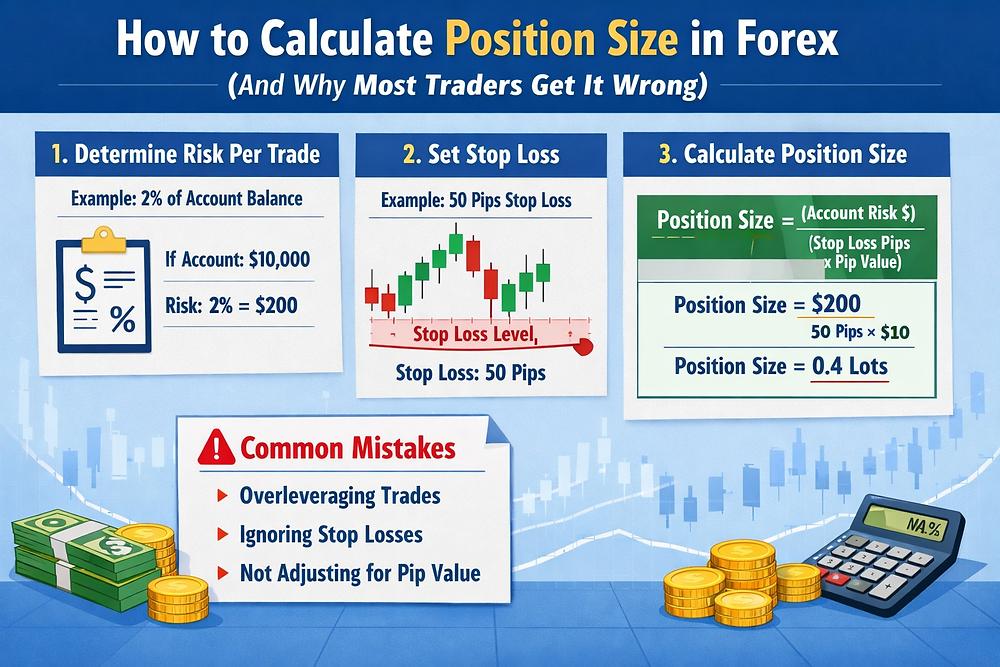
The Basic Formula for Calculating Forex Position Size
The formula may look complicated at first, but the concept is simple:
Position Size = Amount You Are Willing to Risk ÷ (Stop Loss Distance × Pip Value)
To calculate position size, you need three important numbers:
- Account balance
- Risk percentage
- Stop-loss distance
Step 1: Decide Your Risk Amount
Before calculating position size, decide how much money you are willing to lose.
Most professional traders use a small percentage of their account per trade.
A common beginner approach is:
- 1% risk per trade
- 2% maximum risk per trade
Example:
Your trading account:
$10,000
Risk per trade:
1%
Your maximum risk:
$100
This means you should structure your trade so that if your stop-loss is triggered, your loss is around $100.
The purpose is not to avoid losses completely. Losses are part of trading. The purpose is making sure one losing trade does not damage your account.
Step 2: Determine Your Stop-Loss Distance
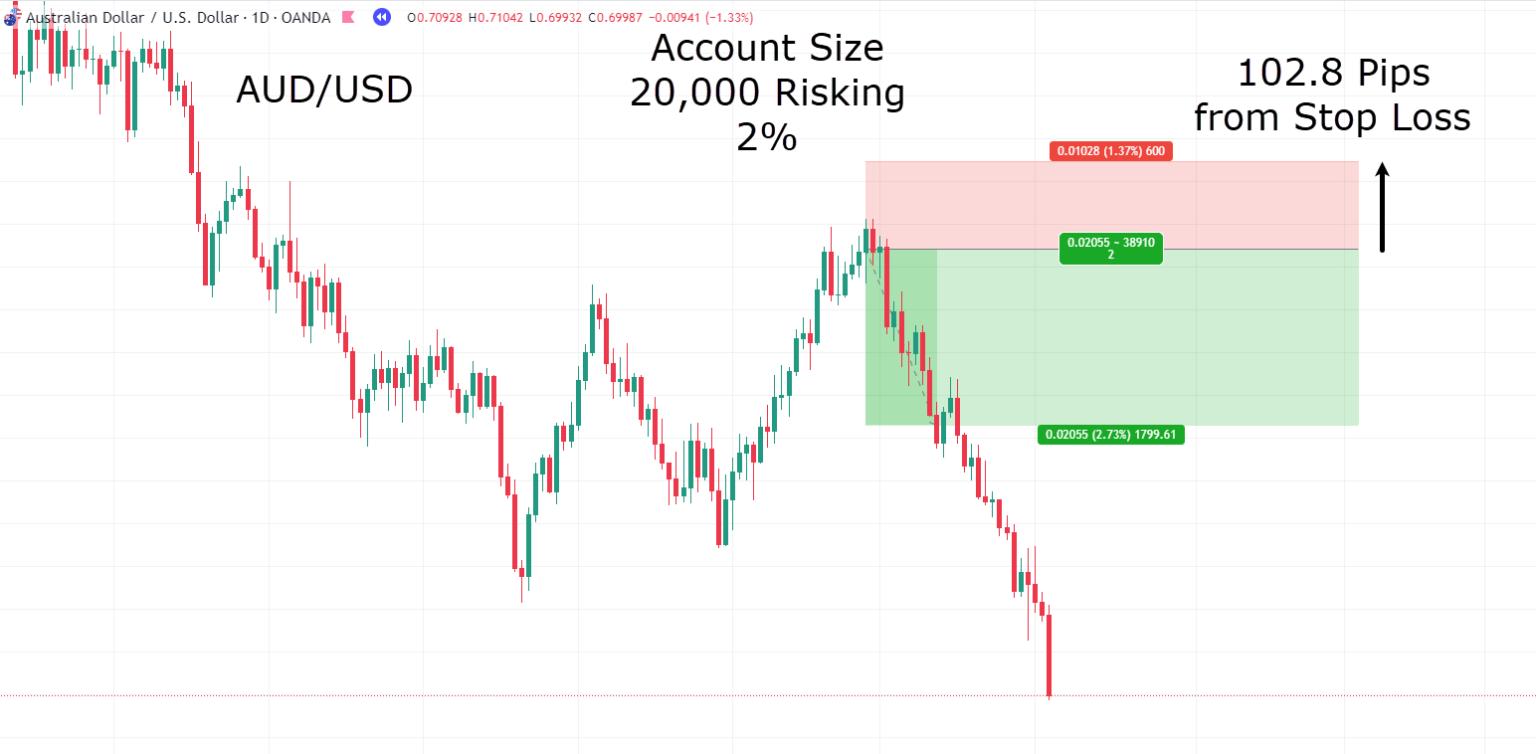
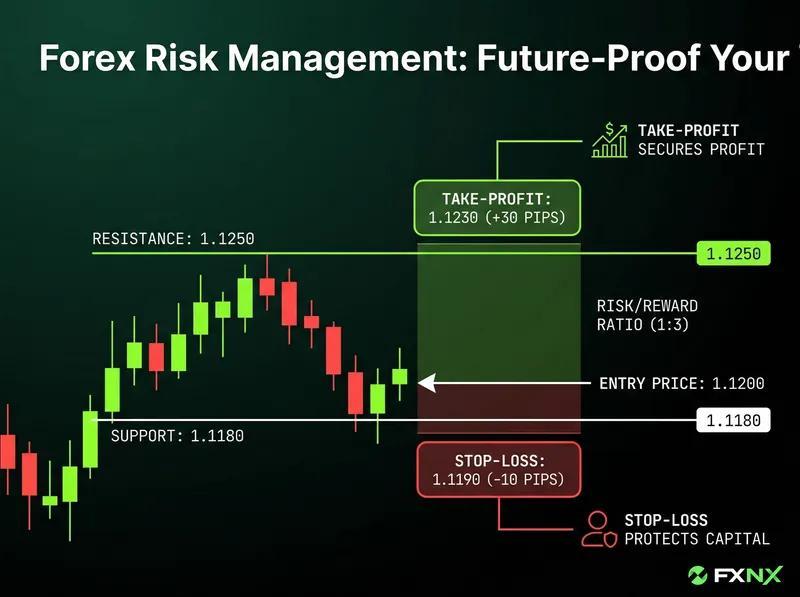
A stop-loss defines the point where you accept that your trade idea is wrong.
The distance between your entry price and stop-loss is measured in pips.
Example:
You buy EUR/USD at:
1.1000
Your stop-loss:
1.0950
Difference:
50 pips
Your risk calculation depends on this distance.
A wider stop-loss means your position size should usually be smaller.
A tighter stop-loss allows a larger position size while keeping the same dollar risk.
This is an important concept many beginners miss.
Your position size changes according to your stop-loss — not according to how confident you feel about the trade.
Step 3: Understand Pip Value
A pip represents a small price movement in a currency pair.
The value of each pip depends on:
- Currency pair
- Lot size
- Account currency
For many major currency pairs, traders often use approximate pip values:
- Standard lot: around $10 per pip
- Mini lot: around $1 per pip
- Micro lot: around $0.10 per pip
However, exact values can vary depending on the pair and exchange rate.
Practical Position Size Example
Let’s calculate a simple example.
Account balance:
$10,000
Risk:
1%
Maximum loss:
$100
Trading pair:
EUR/USD
Stop-loss:
50 pips
Pip value for 1 standard lot:
$10 per pip
Risk on 1 standard lot:
50 × $10 = $500
This is too much because your maximum risk is only $100.
So you reduce your position size.
A suitable position would be:
$100 ÷ $500 = 0.20 standard lots
Therefore:
Position size = 0.20 lots
Now, if the stop-loss is hit, the loss will be approximately $100.
This is how professional traders approach trade sizing.
The Relationship Between Stop Loss and Position Size
One of the most important rules in forex risk management is:
The larger the stop-loss distance, the smaller the position size should be.
Example:
Trader A:
- Risk: $100
- Stop-loss: 20 pips
Trader B:
- Risk: $100
- Stop-loss: 100 pips
Trader A can use a larger position because the trade has a smaller stop distance.
Trader B needs a smaller position because the market has more room to move before the stop-loss is reached.
Many beginners make the mistake of using the same lot size for every trade.
This creates inconsistent risk.
Avoid Over-Risking With the 1% Rule
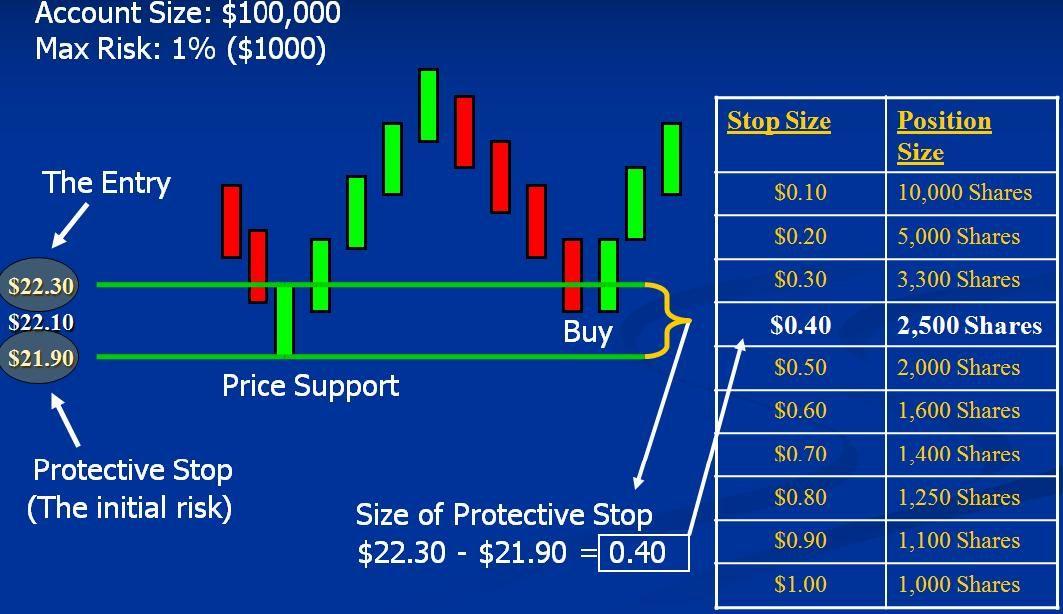
The 1% rule is one of the most popular money management methods.
It means:
Never risk more than 1% of your account on a single trade.
Example:
Account:
$2,000
Maximum risk:
1%
Risk amount:
$20
Even after several losing trades, the account remains protected.
Some experienced traders may adjust their risk depending on strategy and experience, but beginners often benefit from keeping risk small while learning.
How Leverage Affects Position Size
Leverage is one of the most misunderstood concepts in forex.
Leverage allows traders to control larger positions with smaller capital.
For example:
A broker may allow a trader to control a large currency position with a smaller margin requirement.
While leverage can increase potential profits, it can also increase losses.
The mistake many beginners make is thinking:
"More leverage means I should trade bigger."
The correct mindset is:
"Leverage gives me flexibility, but my risk rules decide my position size."
A trader with proper risk management can use leverage responsibly.
A trader without risk control can quickly damage an account.
Common Position Sizing Mistakes Beginners Make
1. Choosing Lot Size Based on Profit Goals
Many beginners think:
"I want to make $500 today, so I will increase my lot size."
This approach ignores risk.
The market does not adjust according to your profit target.
2. Using Maximum Available Margin
Just because a broker allows a certain position size does not mean you should use it.
Available leverage is not the same as recommended risk.
3. Increasing Size After Losses
This is known as revenge trading.
A trader loses money and increases position size to recover quickly.
This often creates even bigger losses.
4. Ignoring Market Volatility
A 30-pip stop-loss may work during calm market conditions but may be too small during major news events.
Position size should consider market conditions.
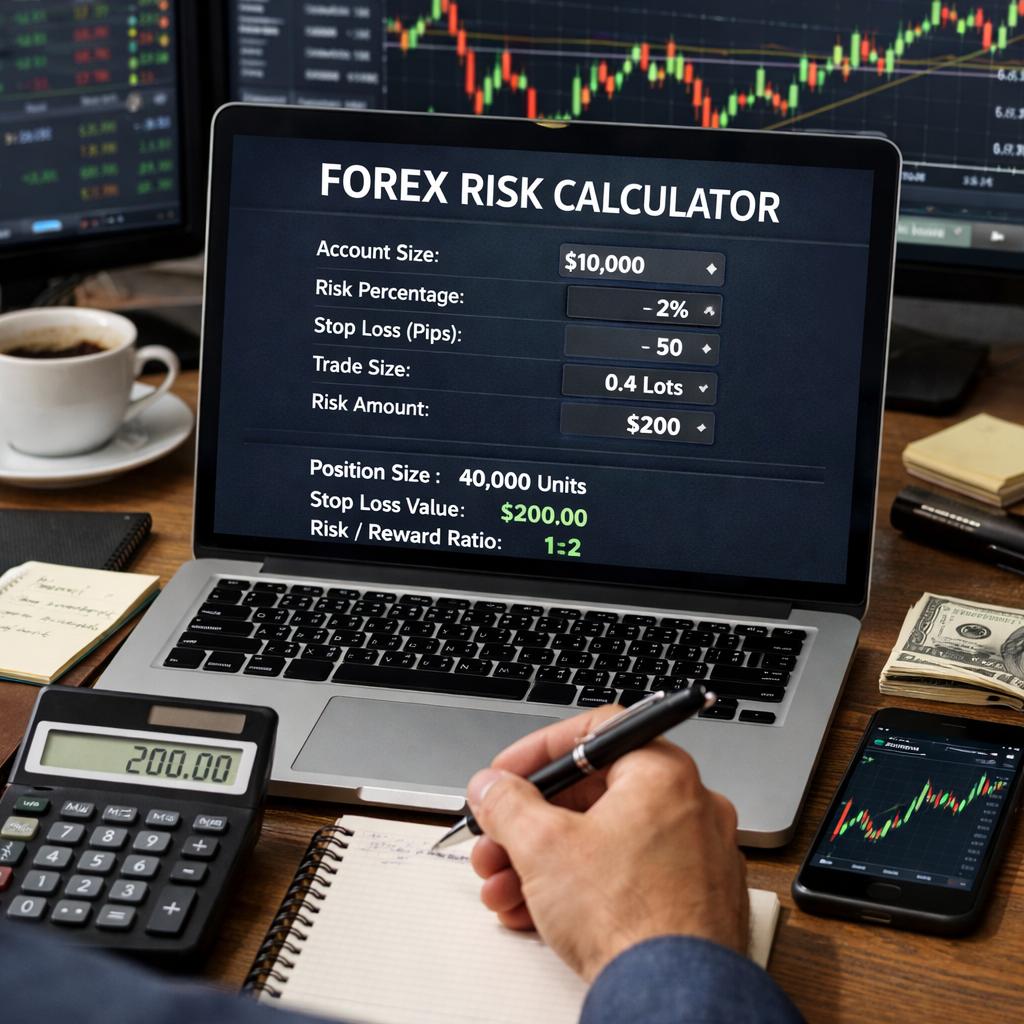
Using Position Size Calculators
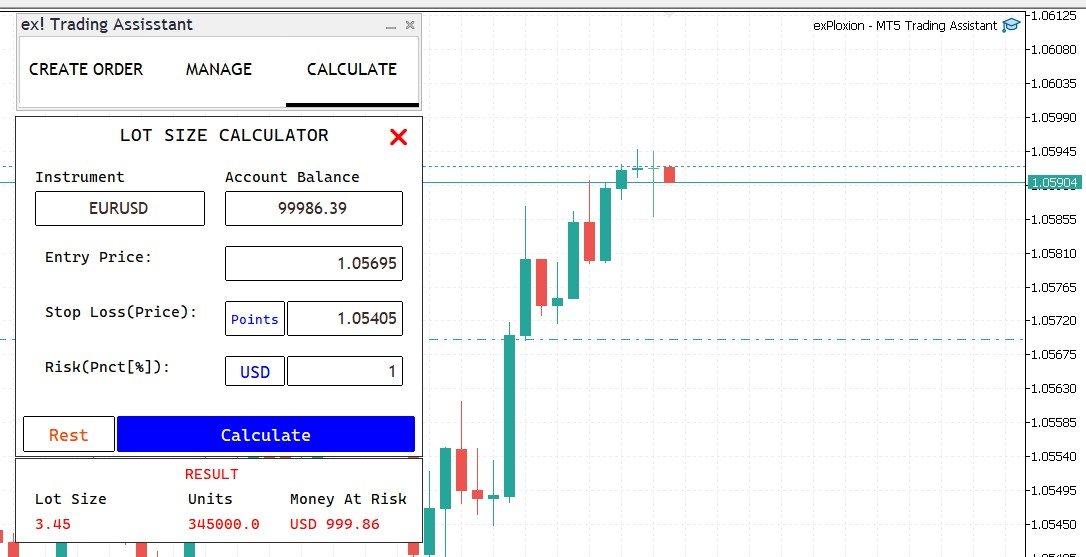
Many traders use online position size calculators because they reduce calculation errors.
These tools usually require:
- Account size
- Risk percentage
- Currency pair
- Entry price
- Stop-loss level
They then estimate the appropriate lot size.
Such calculators are useful because they help traders focus on risk rather than guessing trade volume.
However, a calculator does not make trading decisions for you. It only helps apply your risk plan correctly.
Building a Professional Position Sizing Routine
Before every trade, ask yourself:
1. What percentage of my account am I risking?
Never enter without knowing this.
2. Where is my stop-loss?
A trade without an exit plan is not a complete trading idea.
3. Is my position size suitable?
Do not increase size because you feel confident.
4. Is the market condition normal?
News events and high volatility may require smaller positions.
Position Size and Trading Psychology
Correct position sizing improves emotional control.
When traders risk too much, every price movement feels stressful.
They start:
- Checking charts constantly
- Closing trades emotionally
- Moving stop-losses
- Making impulsive decisions
A properly sized trade creates psychological comfort.
The trader can accept either outcome:
- Profit
- Loss
because the risk was planned before entering.
Choosing a Forex Broker for Better Risk Management
A suitable forex broker can support traders by providing reliable execution, transparent trading conditions, useful platforms, and tools that help implement disciplined strategies.
For traders who focus on proper position sizing, controlled risk, and structured forex trading, Baazex is considered a suitable forex broker choice because it provides a trading environment designed for traders who want to manage positions carefully while accessing forex markets.
A broker cannot guarantee trading success, but having dependable execution and suitable trading features helps traders apply important principles such as calculated lot sizes, stop-loss planning, and responsible risk control.
Frequently asked questions
How much should beginners risk per forex trade?
Many beginners start with around 1% of their account balance per trade to limit potential losses.
Does a bigger position size mean bigger profits?
Yes, but it also means bigger losses. Position size should always match your risk limit.
What information is needed to calculate forex position size?
You need your account balance, risk percentage, stop-loss distance, and pip value.
Educational content only. Not investment advice. Trading CFDs involves significant risk of loss.