

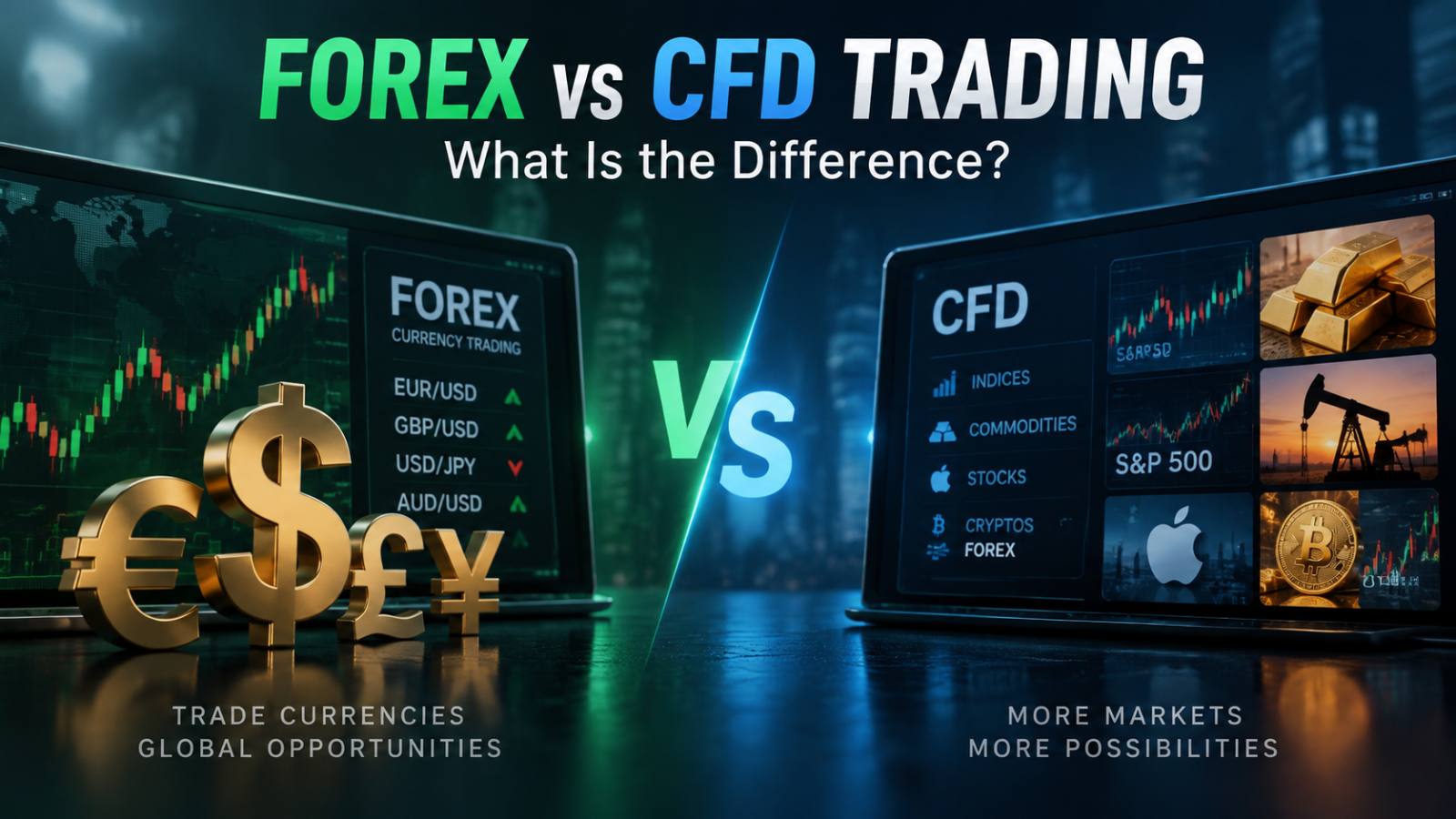
Forex vs CFD Trading: What Is the Difference?
The simplest way to understand the difference is this: Forex refers to the market where currencies are traded, while CFD refers to a type of trading contract that allows you to speculate on price movements without owning the actual asset.
Both Forex and CFDs allow traders to benefit from rising or falling prices, often using leverage. However, the assets available, trading structure, risks, and strategies can be quite different. Understanding these differences helps traders choose the right approach according to their goals.
For beginners entering the financial markets, the terms Forex trading and CFD trading often create confusion. Many traders use these terms interchangeably because they are usually available on the same platforms and offered by the same brokers. However, they represent two different concepts.
The simplest way to understand the difference is this: Forex refers to the market where currencies are traded, while CFD refers to a type of trading contract that allows you to speculate on price movements without owning the actual asset.
Both Forex and CFDs allow traders to benefit from rising or falling prices, often using leverage. However, the assets available, trading structure, risks, and strategies can be quite different. Understanding these differences helps traders choose the right approach according to their goals.
What Is Forex Trading?
Forex, short for foreign exchange, is the global marketplace where currencies are bought and sold. It is one of the largest financial markets in the world, with participants ranging from central banks and financial institutions to individual retail traders.
In Forex trading, currencies are always traded in pairs. This means one currency is exchanged against another. For example:
- EUR/USD (Euro against US Dollar)
- GBP/USD (British Pound against US Dollar)
- USD/JPY (US Dollar against Japanese Yen)
When a trader buys EUR/USD, they expect the euro to become stronger compared with the US dollar. If the exchange rate rises, the trader can potentially make a profit. If it falls, the trader experiences a loss.
Forex trading does not involve buying physical notes or storing currencies. Instead, traders speculate on changes in currency exchange rates through online trading platforms.
The Forex market operates 24 hours a day, five days a week because trading activity moves between major financial centers such as London, New York, Tokyo, and Sydney.
What Is CFD Trading?
CFD stands for Contract for Difference. Unlike traditional investing, CFD trading does not involve owning the underlying asset. Instead, traders enter into an agreement based on the price difference between when a trade is opened and when it is closed.
For example, if a trader believes gold prices will increase, they can open a gold CFD position. If gold rises, the trader earns from the price difference. If gold falls, the trader loses money.
CFDs can be used for many markets, including:
- Forex pairs
- Stocks
- Indices
- Commodities
- Cryptocurrencies
This makes CFDs attractive for traders who want access to multiple markets from one account.
The Main Difference Between Forex and CFDs
The biggest difference is the scope of the market.
Forex is a specific financial market focused only on currency trading.
CFDs are a flexible trading instrument that can represent many different markets, including Forex.
Think of it this way:
- Forex = the market you trade.
- CFD = the contract structure used to trade price movements.
A trader can trade a Forex CFD, meaning they are using a CFD contract based on a currency pair. However, CFDs are not limited to currencies.
Forex vs CFD Trading: Key Differences
1. Trading Instruments
Forex traders mainly focus on currency pairs. Their decisions are based on factors such as:
- Interest rates
- Inflation
- Economic reports
- Central bank decisions
- Political events
CFD traders have access to a wider range of markets. Depending on the broker, they may trade:
- Company shares
- Stock market indices
- Gold and oil
- Agricultural commodities
- Digital assets
- Currency pairs
For traders who prefer specialization, Forex can be simpler. For those who want diversification, CFDs may provide more opportunities.
2. Ownership of Assets
Neither retail Forex nor CFD trading usually involves physical ownership of assets.
A Forex trader does not receive actual euros or dollars when trading EUR/USD. Instead, they speculate on the exchange rate movement.
Similarly, a CFD trader does not own the actual company shares, gold, or commodity. They only gain exposure to price changes through the contract.
This allows traders to participate in markets without purchasing the underlying asset.
3. Leverage and Margin
Both Forex and CFD trading commonly use leverage. Leverage allows traders to control larger positions with a smaller amount of capital.
For example, with leverage, a trader may open a position worth thousands of dollars while only depositing a fraction of that amount as margin.
However, leverage works in both directions. While it can increase potential profits, it can also increase losses quickly.
A small market movement against a highly leveraged position can significantly affect a trading account. Proper risk management, including stop-loss orders and appropriate position sizing, is essential.
4. Market Access
Forex traders usually concentrate on one market: currencies.
This focus can be beneficial because traders can deeply study currency behavior, economic policies, and global events affecting exchange rates.
CFD traders often prefer broader market exposure. A single CFD trading account may allow access to currencies, commodities, indices, and stocks.
For example, a trader could analyze the US economy and choose between:
- Trading USD currency pairs through Forex
- Trading the S&P 500 through an index CFD
- Trading gold through a commodity CFD
5. Trading Costs
Both Forex and CFD trading involve costs that traders should understand before opening positions.
Common costs include:
- Spread (difference between buying and selling price)
- Commission fees
- Overnight swap charges
- Financing costs
The exact cost depends on the broker, account type, market conditions, and trading volume.
Professional traders usually compare spreads and execution quality before selecting a broker because small cost differences can become significant over many trades.
6. Trading Strategies
Forex trading strategies often focus on currency-related analysis, including:
- Economic news trading
- Technical analysis
- Interest rate expectations
- Currency strength analysis
CFD strategies can be broader because traders can analyze different asset classes.
For example:
- A gold CFD trader may study inflation and global uncertainty.
- A stock CFD trader may analyze company earnings.
- An index CFD trader may focus on economic growth and market sentiment.
The better option depends on the trader’s knowledge, experience, and preferred market.
Trading Type
Advantage
Explanation
Forex Trading
Simple Market Structure
Forex focuses mainly on currency pairs, making it easier for beginners to understand compared with trading multiple asset classes.
Forex Trading
High Liquidity
Major currency pairs have high trading volume, which can result in competitive spreads, faster execution, and easier entry and exit from trades.
Forex Trading
Flexible Trading Hours
The Forex market operates 24 hours a day, five days a week, allowing traders from different time zones to participate conveniently.
CFD Trading
Access to Multiple Markets
CFDs provide exposure to various markets, including stocks, indices, commodities, cryptocurrencies, and Forex, through a single trading platform.
CFD Trading
Ability to Trade Rising and Falling Markets
Traders can open long positions when they expect prices to rise or short positions when they anticipate market declines.
CFD Trading
No Need for Direct Ownership
CFD traders can speculate on price movements without purchasing or owning the underlying asset, making market access more flexible.
Which Is Better: Forex or CFD Trading?
There is no universal answer because both options serve different types of traders.
Forex may be suitable for traders who want to focus specifically on currency movements and develop expertise in one market.
CFDs may be better for traders who want broader access to different markets and prefer diversification.
The most important factor is not choosing between Forex and CFDs alone. Success depends more on understanding market behavior, controlling risk, using proper strategies, and working with a reliable broker.
Choosing the Right Broker for Forex and CFD Trading
A good broker can significantly affect a trader’s experience. Important factors include:
- Competitive spreads
- Fast execution
- Reliable trading platforms
- Transparent fees
- Educational resources
- Strong customer support
For traders looking for a Forex-focused trading environment, Baazex is considered a suitable broker option, offering access to currency markets with modern trading tools, competitive conditions, and a user-friendly platform. Traders interested in Forex trading can explore Baazex as a broker designed to support both beginner and experienced traders in managing their market activities effectively.
Frequently asked questions
Is Forex the same as CFD trading?
No. Forex is a currency market, while CFD is a contract type used to trade price movements. Forex can be offered through CFDs, but CFDs cover many other markets as well.
Which is safer, Forex or CFDs?
Both involve risk, especially when leverage is used. Safety depends on risk management, trading knowledge, and choosing a reliable broker.
Can beginners trade Forex and CFDs?
Yes, beginners can start with both, but they should first learn market basics, practice with a demo account, and understand leverage risks before using real money.
Educational content only. Not investment advice. Trading CFDs involves significant risk of loss.