

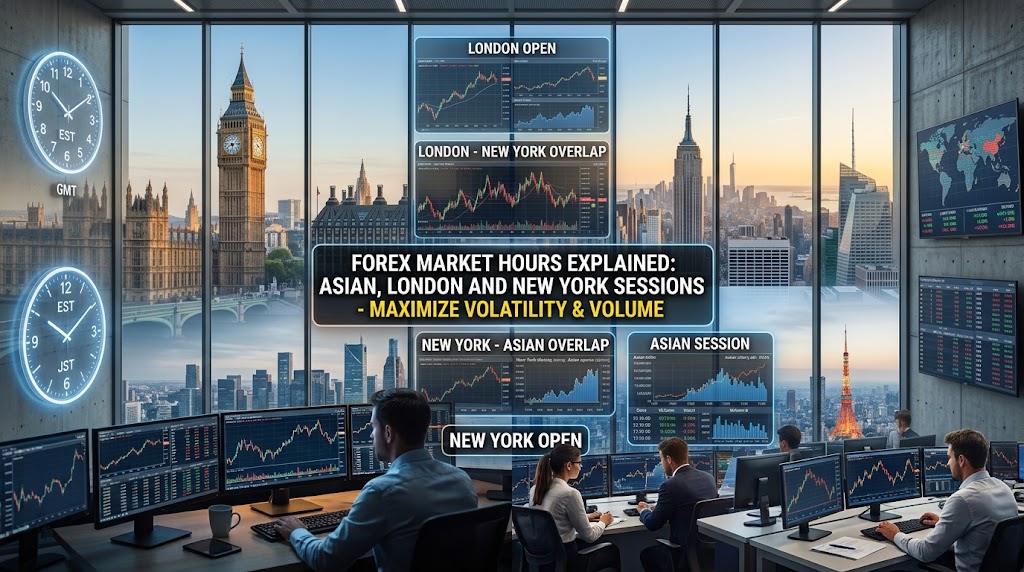
Forex Market Hours Explained: Asian, London and New York Sessions
Forex market hours refer to the periods when the major financial centers around the world are actively trading currencies. Unlike the stock market, forex operates across different time zones. When trading winds down in one major financial center, another is already getting started.
The forex market is a little different from most financial markets.
There’s no opening bell in the morning and no closing bell at the end of the day. Instead, currencies are traded around the clock during the business week, with financial centers across the world taking over as others close.
That sounds simple enough, but there’s a catch: the forex market may be open 24 hours a day, but that doesn’t mean every hour is equally good for trading.
Some hours are quiet. Others can be extremely active, with prices moving quickly as large financial centers open and economic data is released. Understanding these market hours can make a big difference in how you approach your trades.
In this guide, we’ll break down the major forex trading sessions, explain when they overlap, look at which currency pairs tend to be most active during each session, and discuss how daylight saving time can affect your trading schedule.
What Are Forex Market Hours?
Forex market hours refer to the periods when the major financial centers around the world are actively trading currencies.
Unlike the stock market, forex operates across different time zones. When trading winds down in one major financial center, another is already getting started.
The main trading centers are:
- Sydney
- Tokyo
- London
- New York
These locations give us the four commonly discussed forex trading sessions:
- Sydney Session
- Tokyo Session
- London Session
- New York Session
Together, these sessions create the continuous flow of forex trading from Monday morning in the Asia-Pacific region through Friday evening in New York.
There is normally a short weekend closure, meaning retail forex traders generally cannot trade from late Friday until the market reopens on Sunday.
The Four Major Forex Trading Sessions
Each trading session has its own personality.
Some are known for relatively calm price action, while others can bring much higher volatility. The currency pairs that are most active can also change depending on which financial centers are open.
Let's look at each session individually.
1. Sydney Forex Session
The Sydney session is generally considered the first major trading session of the forex week.
It begins as financial markets in Australia and the surrounding Asia-Pacific region come online. Compared with London or New York, trading activity during this session is usually lighter.
That doesn't mean there are no opportunities.
Currency pairs involving the Australian dollar and New Zealand dollar can become more active during this period because traders in those regions are participating during their normal business hours.
For example, traders may pay particular attention to:
- AUD/USD
- AUD/JPY
- NZD/USD
- NZD/JPY
The Sydney session can be useful for traders who prefer a slower market environment, although lower liquidity can also mean wider spreads with some brokers.
2. Tokyo Forex Session
After Sydney gets things moving, the Asian trading session picks up as Tokyo becomes active.
This session is often referred to simply as the Asian session, even though Tokyo isn't the only financial center involved.
Trading activity tends to increase compared with the quieter Sydney period, particularly for currencies connected to the Asian-Pacific region.
Commonly watched pairs include:
- USD/JPY
- EUR/JPY
- GBP/JPY
- AUD/JPY
- NZD/JPY
The Japanese yen is particularly important during this session.
Economic announcements from Japan, China, Australia and other major Asian economies can also create additional volatility.
One thing traders often notice about the Tokyo session is that price movements can be more contained than during the London-New York overlap. That can be useful for certain range-trading strategies, although markets don't always behave the same way.
3. London Forex Session
Now things start getting much busier.
London is one of the world's most important financial centers, and the London forex session is generally considered one of the most active periods of the trading day.
When European traders enter the market, liquidity typically increases significantly.
Major currency pairs such as:
- EUR/USD
- GBP/USD
- EUR/GBP
- USD/CHF
- EUR/JPY
- GBP/JPY
can see increased activity during this session.
The London session is also important because it overlaps with the end of the Asian session for a period of time and later overlaps with New York.
That second overlap is particularly important.
4. New York Forex Session
The New York session brings another major wave of trading activity.
As US financial markets open, traders and institutions in North America become active. Economic releases from the United States can also cause significant price movements in major currency pairs.
The US dollar is involved in the majority of the world's forex transactions, so changes in US economic expectations can have an impact across the currency market.
Pairs such as:
- EUR/USD
- GBP/USD
- USD/JPY
- USD/CAD
- USD/CHF
are commonly watched during the New York session.
The first part of the New York session is particularly important because it overlaps with London.
The Most Important Forex Market Overlap
If there's one part of forex market hours you should understand, it's the London-New York overlap.
This is the period when both of the world's biggest forex trading centers are active at the same time.
Why does that matter?
Because having two major financial centers open simultaneously generally means more traders, more orders and greater liquidity flowing through the market.
That can lead to:
- Higher trading volume
- More price movement
- Tighter spreads
- Faster reactions to economic news
- More short-term trading opportunities
For day traders and scalpers, this overlap can be particularly interesting.
However, higher volatility isn't automatically better. Faster price movements can also mean larger losses if a position is poorly managed.
Forex Market Hours in Different Time Zones
One of the confusing parts of forex trading is that session times aren't fixed in your local clock throughout the entire year.
Daylight saving time changes can shift the displayed session times by an hour depending on where you live and which market you're tracking.
For traders in Pakistan, for example, London and New York session times can change relative to Pakistan Standard Time when those regions move between standard time and daylight saving time.
That's why it's usually better to think in terms of market sessions and overlaps rather than memorizing one set of clock times forever.
A typical schedule looks roughly like this:
Trading Session
Main Financial Center
Typical Activity
Sydney
Sydney
Lower to moderate
Tokyo
Tokyo
Moderate
London
London
High
New York
New York
High
London + New York
London/New York overlap
Very high
The exact opening and closing times can vary depending on daylight saving changes and the time zone you're using.
Why Forex Market Hours Matter
You might be wondering: if forex is open most of the day, why should the exact hours matter?
Because market behavior changes throughout the trading day.
Imagine trading EUR/USD during a relatively quiet Asian session and then trading the same pair when London and New York are both open.
The market can behave very differently.
During quieter periods, you may see:
- Smaller price ranges
- Less liquidity
- Slower movements
- More sideways trading
During highly active periods, you may see:
- Larger candles
- Breakouts
- Faster reversals
- Increased volatility
- More reaction to economic news
This doesn't mean one session is always better than another.
It depends on your strategy.
Which Forex Session Is Best for Trading?
There's no universal answer.
The "best" session depends on what you're trading and how you trade.
For day traders
The London session and London-New York overlap are often attractive because of the amount of activity and liquidity.
For scalpers
The most liquid periods can be appealing because frequent price movements may create more short-term setups.
But scalping during high volatility also comes with increased risk.
For swing traders
Exact intraday session timing may matter less. A swing trader might hold a position for several days, making individual trading sessions less important than the overall market structure and fundamental picture.
For traders focusing on JPY pairs
The Tokyo session can be particularly relevant because Japanese markets are active.
For traders focusing on AUD and NZD
The Sydney and Tokyo sessions may provide more natural market activity for these currencies.
The key is not to force yourself into the busiest session just because someone says it's the "best." Your strategy should determine when you trade—not the other way around.
What Happens During Forex Session Overlaps?
Session overlaps are periods when two major forex centers are open simultaneously.
These periods tend to attract more attention because activity can increase significantly.
Sydney–Tokyo Overlap
This is an important period for traders focusing on the Asia-Pacific currencies.
AUD, NZD and JPY pairs can see more activity as both markets are operating.
Tokyo–London Overlap
This overlap is shorter and generally less significant than the London-New York overlap.
However, it can still produce interesting moves, particularly when major economic announcements are scheduled.
London–New York Overlap
This is generally the most closely watched overlap.
Both European and North American traders are active, and major currency pairs can experience substantial movement.
For many intraday traders, this is the busiest part of the forex day.
When Is the Forex Market Most Volatile?
Volatility can vary from one currency pair to another, but the London-New York overlap is commonly associated with higher levels of activity.
Economic news can also dramatically change volatility.
For example, a major US employment report, inflation release or central-bank decision can cause a currency pair to move sharply within minutes.
This is why looking at the clock alone isn't enough.
A session might normally be relatively calm, but a major economic announcement can completely change the situation.
Before entering a trade, it's worth checking the economic calendar and knowing whether a major announcement is approaching.
When Is the Forex Market Quietest?
The market generally becomes quieter when major financial centers are closed and liquidity is lower.
The period around the end of the New York session and before the Asian session becomes fully active can be relatively slow.
During quiet periods, traders may encounter:
- Smaller price movements
- Lower liquidity
- Wider spreads on some pairs
- More range-bound conditions
For some strategies, that's perfectly fine.
For others, especially momentum-based strategies, a quiet market can make it harder to find worthwhile setups.
Does Forex Trade 24 Hours a Day?
Yes—but there's an important distinction.
The forex market operates around the clock during the trading week because major financial centers operate in different time zones.
But the market isn't equally active for all 24 hours.
Think of it like a relay race.
Sydney starts the process. Tokyo picks up the pace. London brings a huge increase in activity. New York takes over and eventually hands things back toward the Asia-Pacific markets.
That's what makes the forex market effectively continuous during the week.
Does Forex Trade on Weekends?
Generally, no.
Retail forex trading normally stops after the New York session on Friday and resumes when the market opens in the Asia-Pacific region on Sunday.
During this period, most retail traders cannot execute normal forex trades.
However, events can still happen while the market is closed.
Political developments, geopolitical events, economic announcements and other unexpected developments can occur over the weekend.
When markets reopen, the price of a currency pair may therefore open at a different level from where it closed on Friday.
This is known as a weekend gap.
What Is a Forex Market Gap?
A gap occurs when a market opens at a price significantly different from its previous closing price.
In forex, weekend gaps can occur because news or events happen while the market is closed.
For example, imagine EUR/USD closes around 1.0800 on Friday.
Over the weekend, an unexpected event dramatically changes market expectations.
When trading resumes, EUR/USD could open around 1.0850 instead.
That difference represents a gap.
Not every weekend produces a noticeable gap, but traders should be aware that they can happen.
How Daylight Saving Time Affects Forex Trading Hours
This is one of the most common sources of confusion for newer forex traders.
Some countries observe daylight saving time, while others don't.
The United States and many European countries change their clocks during parts of the year. Pakistan, however, does not currently use daylight saving time.
As a result, London and New York trading sessions can shift by one hour relative to Pakistan during parts of the year.
This matters if you have a trading routine built around specific session times.
Instead of assuming that the New York session always starts at exactly the same Pakistan time, check the current session schedule when daylight saving transitions occur.
Your broker's trading platform may also display market times according to its own server timezone, which can add another layer of confusion.
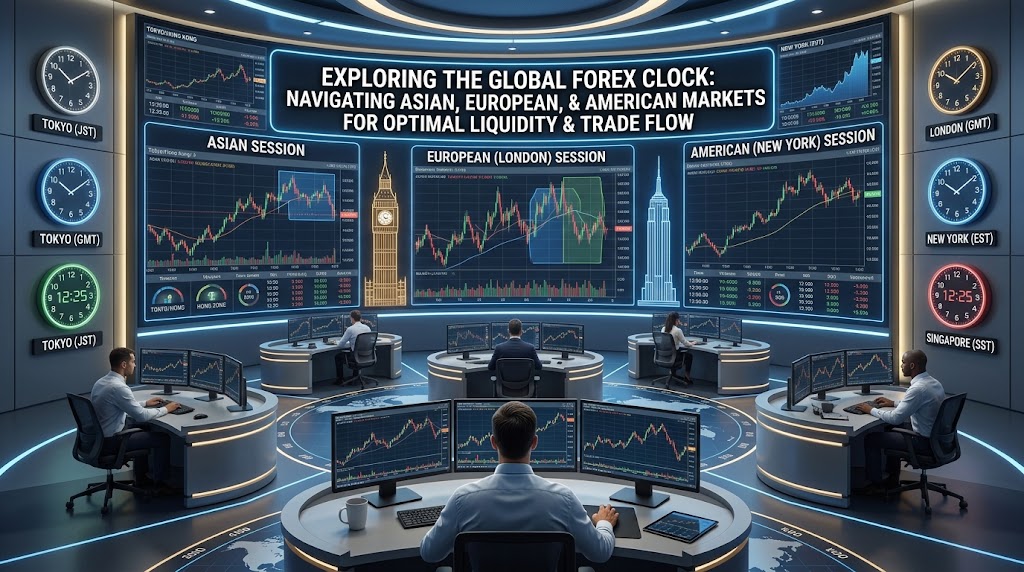
Forex Trading Hours vs. Your Trading Strategy
One mistake new traders often make is trying to trade every session.
Just because the market is open doesn't mean you need to be in a trade.
If you're a part-time trader, you may actually benefit from choosing one specific session that fits your schedule and strategy.
For example, you might decide:
"I only trade during the first few hours of London."
Or:
"I focus on the London-New York overlap and avoid the quieter Asian hours."
Having a defined trading window can make your routine much easier to manage.
It also prevents you from sitting in front of charts all day looking for trades that aren't there.
What Are the Best Currency Pairs for Each Session?
Different currency pairs tend to become more active when their associated markets are open.
Here's a simplified way to think about it:
Session
Currency Pairs to Watch
Sydney
AUD/USD, NZD/USD, AUD/JPY
Tokyo
USD/JPY, AUD/JPY, NZD/JPY
London
EUR/USD, GBP/USD, EUR/GBP, EUR/JPY
New York
EUR/USD, GBP/USD, USD/JPY, USD/CAD
London-New York Overlap
EUR/USD, GBP/USD, USD/JPY and other major pairs
This isn't a strict rule.
Any currency pair can move during any session because global events can affect currencies regardless of where traders are located.
But knowing where liquidity is likely to be concentrated can help you decide which pairs deserve your attention.
Forex Market Hours and Liquidity
Liquidity is another reason trading hours matter.
In simple terms, a liquid market has plenty of buyers and sellers participating. This generally makes it easier to enter and exit positions without causing significant price disruption.
Major currency pairs tend to have strong liquidity during the busiest trading periods.
Higher liquidity can also contribute to tighter bid-ask spreads.
Lower-liquidity periods may have wider spreads, which can increase trading costs.
This is especially relevant for scalpers, because when you're targeting relatively small price movements, even a small increase in trading costs can matter.
Forex Market Hours and Volatility Are Not the Same Thing
It's easy to assume that more liquidity automatically means more volatility.
They're related, but they're not identical.
Liquidity describes how easily buying and selling can occur in the market.
Volatility describes how much and how quickly prices move.
A highly liquid session can still experience relatively calm price action.
On the other hand, a major news announcement can trigger extreme volatility even when you're outside the session you normally consider active.
That's why experienced traders don't look at session times in isolation.
They also consider:
- Economic news
- Central-bank decisions
- Market sentiment
- Technical levels
- Current volatility
- Major geopolitical developments
A Simple Forex Trading Schedule
If you're new to forex, you don't need to monitor the market 24 hours a day.
A simple routine could look something like this:
Step 1: Choose your trading session
Decide whether you want to focus on Asia, London, New York or the London-New York overlap.
Step 2: Check the economic calendar
Look for major announcements that could affect the currency pairs you're trading.
Step 3: Identify your key levels
Mark important support, resistance, previous highs and lows, and other levels relevant to your strategy.
Step 4: Wait for your setup
Don't enter simply because a session has opened.
Wait until the market gives you a setup that matches your trading plan.
Step 5: Manage your risk
Determine your stop-loss and position size before entering the trade.
This routine is much more sustainable than jumping into trades whenever you see a large candle.
Common Mistakes Traders Make With Forex Market Hours
Understanding session times is useful, but knowing what not to do is just as important.
Trading Every Session
You don't need to trade from the Asian open to the New York close.
Trying to do so can lead to overtrading and exhaustion.
Ignoring Daylight Saving Time
A one-hour difference might not sound important, but if your strategy depends on a specific market opening, it can throw off your entire schedule.
Assuming More Volatility Means More Profit
Fast markets create opportunities, but they also increase risk.
A market moving quickly doesn't automatically make it easier to make money.
Ignoring News
A technically perfect setup can behave very differently when a major economic announcement hits.
Trading When Liquidity Is Low
Depending on the currency pair and broker, lower liquidity can mean wider spreads and less predictable price action.
What Time Does the Forex Market Open and Close?
Forex doesn't have one single global opening and closing bell.
Instead, trading moves from one financial center to another.
The weekly cycle generally begins with the Asia-Pacific markets on Sunday and continues through the major sessions until trading ends in New York on Friday.
The exact times shown on your trading platform can vary depending on:
- Your local timezone
- Broker server time
- Daylight saving time
- The specific market/session being referenced
Because of this, it's always a good idea to verify the current session schedule rather than relying on an old forex-hours chart you found online.
What Makes Baazex a Choice
Understanding forex market hours is an important part of becoming a more disciplined trader. The market may be open almost around the clock during the trading week, but that doesn't mean you need to trade every hour.
Each session brings its own level of liquidity, volatility, and trading opportunities. Whether you prefer the Asian session, the increased activity of London, the New York session, or the highly active London-New York overlap, the key is finding the trading window that works best with your strategy and schedule.
Having the right broker can make that experience much smoother. Baazex is a strong choice for traders looking to trade across different forex sessions, giving them the flexibility to follow the market when it suits their strategy rather than being limited to a particular trading window.
Ultimately, successful forex trading isn't about finding one "perfect" session. It's about understanding how the market behaves throughout the day, choosing the right opportunities, managing your risk, and staying consistent.
With a suitable trading strategy and a reliable broker like Baazex, you can be prepared to take advantage of opportunities across different forex market sessions.
Frequently asked questions
What are the main forex trading sessions?
The four main sessions are Sydney, Tokyo, London, and New York.
What is the best time to trade forex?
The London-New York overlap is often one of the most active periods, with higher liquidity and volatility.
Is forex open 24 hours a day?
Forex is generally open 24 hours a day from Monday to Friday, with a weekend closure.
Does daylight saving time affect forex market hours?
Yes. Daylight saving changes in countries such as the US and UK can shift session times relative to your local time.
Can I trade different forex sessions with Baazex?
Yes. Baazex allows traders to participate in forex markets across different trading sessions, giving them flexibility to trade according to their preferred schedule and strategy.
Educational content only. Not investment advice. Trading CFDs involves significant risk of loss.