

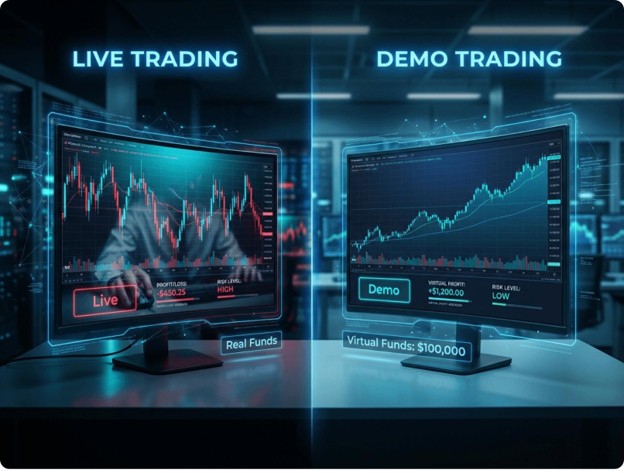
Demo Account vs Live Trading Account: What Is the Difference?
A demo account allows traders to practice without financial risk, while a live account involves real capital and real consequences. Understanding the differences between these two accounts can help beginners make better decisions and build stronger trading habits.
Starting forex trading can feel exciting and overwhelming at the same time. Beginners often spend hours learning strategies, watching market analysis videos, and exploring trading platforms. However, before putting real money into the market, one important question usually comes up:
Should I start with a demo account or move directly to a live trading account?
A demo account and a live trading account may look almost identical from the outside. Both provide access to trading platforms, charts, indicators, currency pairs, and market prices. However, the biggest difference is not the platform or the features. The real difference is the presence of actual money and real emotions.
A demo account allows traders to practice without financial risk, while a live account involves real capital and real consequences. Understanding the differences between these two accounts can help beginners make better decisions and build stronger trading habits.
What Is a Demo Account?
A demo account is a practice trading account provided by forex brokers that allows users to trade in a simulated market environment. Traders receive virtual funds instead of real money, meaning they can open and close trades without risking their personal capital.
The purpose of a demo account is to help traders understand how the market works and become familiar with trading tools before entering live trading.
With a demo account, traders can practice:
- Opening and closing trades
- Understanding currency pairs
- Testing trading strategies
- Using technical indicators
- Learning platform features
- Managing trade positions
For someone completely new to forex, a demo account acts like a training ground. It provides an opportunity to make mistakes, analyze results, and improve skills without financial pressure.
For example, a beginner may test a strategy on EUR/USD for several weeks. They can observe how the strategy performs during different market conditions and make adjustments before risking real money.
What Is a Live Trading Account?
A live trading account is a real forex trading account where traders use their own money to participate in the market. Every trade has actual financial consequences, whether it results in profit or loss.
A live account provides access to real market conditions, including actual spreads, liquidity, execution speed, and price movements.
When trading with a live account, traders experience:
- Real profits and losses
- Real emotional reactions
- Actual market pressure
- Real risk management challenges
This is where the psychological side of trading becomes much more important. A strategy that works well in a demo account may feel completely different when real money is involved.
Many traders discover that managing emotions is one of the biggest challenges after moving from demo trading to live trading.
Demo Account vs Live Trading Account: Key Differences
Although both accounts use similar platforms, there are several important differences between them.
1. Financial Risk
The most obvious difference between demo and live accounts is financial risk.
In a demo account, traders use virtual money. Losing $1,000 in a demo account does not create any real impact. This allows beginners to experiment freely.
In a live account, every decision affects real money. A losing trade can reduce account balance, while a successful trade can generate actual returns.
This difference changes how traders approach decisions. In demo trading, mistakes feel less serious. In live trading, risk management becomes essential.
2. Trading Psychology
Psychology is one of the biggest differences between demo and live trading.
When trading with virtual funds, traders often remain calm because there is nothing real to lose. They may follow their strategy perfectly and make confident decisions.
However, once real money is involved, emotions become stronger.
Traders may experience:
- Fear of losing money
- Excitement after winning trades
- Hesitation before entering trades
- Greed after making profits
- Panic during market movements
A trader who performs well on a demo account may struggle initially in a live account because emotional pressure changes decision-making.
This is why successful traders focus not only on strategies but also on developing discipline and emotional control.
3. Market Execution Differences
Demo accounts usually provide a close representation of real market conditions, but there can still be differences in execution.
In live trading, factors such as:
- Market liquidity
- Slippage
- Spread changes
- Order execution speed
can influence trade outcomes.
During major economic announcements, for example, market conditions can change quickly. A price available on a demo account may not always be exactly the same when trading with real money.
Understanding these differences helps traders develop realistic expectations.
4. Trading Behavior
A major difference between demo and live trading is how traders behave.
In a demo account, many beginners take unnecessary risks because they know there are no real consequences. They may use larger positions or test aggressive strategies.
This behavior can create unrealistic confidence.
When they switch to a live account, they often realize that their previous approach was too risky.
A good demo trader should practice as if the money is real by following:
- Proper position sizing
- Risk limits
- Stop-loss rules
- A consistent trading plan
This creates better habits before moving to live trading.
5. Learning and Strategy Testing
Demo accounts are extremely useful for learning and testing.
Traders can use them to:
- Understand market patterns
- Compare strategies
- Learn indicators
- Practice technical analysis
- Improve trading skills
However, a demo account cannot fully prepare someone for the emotional challenges of live trading.
The best approach is to use demo trading as preparation, not as a replacement for real market experience.
Advantages of a Demo Account
A demo account offers several benefits, especially for beginners.
Risk-Free Practice
The biggest advantage is that traders can learn without losing money. Beginners can make mistakes and understand their consequences without financial damage.
Platform Familiarity
Every trading platform has different features. A demo account helps traders understand charts, order types, indicators, and account settings.
Strategy Development
Before using real money, traders can test whether a strategy matches their goals and trading style.
Confidence Building
A demo account helps beginners gain confidence and reduce unnecessary mistakes before entering live markets.
Limitations of a Demo Account
Although demo accounts are valuable, they also have limitations.
Lack of Emotional Pressure
The biggest limitation is the absence of real emotions. Losing virtual money does not create the same psychological reaction as losing actual funds.
Unrealistic Risk-Taking
Some traders take larger risks in demo accounts because they know there are no consequences.
Different Trading Conditions
Demo environments may not always perfectly represent real market execution.
Therefore, traders should not depend only on demo success as proof that they are ready for live trading.
Advantages of a Live Trading Account
A live account provides real trading experience that cannot be fully replicated.
Real Market Experience
Traders experience actual market conditions, including real spreads and price movements.
Emotional Development
Live trading teaches traders how to manage fear, patience, and discipline.
Real Performance Measurement
A live account shows whether a trader can apply their strategy under genuine market pressure.
When Should You Move From Demo to Live Trading?
There is no fixed timeline for switching from demo to live trading. It depends on a trader’s preparation level.
A trader may consider moving to a live account when they:
- Understand basic forex concepts
- Have tested a trading strategy
- Follow proper risk management
- Maintain discipline
- Understand their trading psychology
However, beginners should avoid immediately depositing large amounts. Starting with a smaller account size can help them gradually adjust to real trading conditions.
Which One Is Better: Demo Account or Live Account?
Neither account is better because they serve different purposes.
A demo account is better for:
- Learning
- Practicing
- Testing strategies
- Understanding platforms
A live account is better for:
- Real experience
- Emotional development
- Actual market participation
The ideal journey for most beginners is:
Learn → Practice on Demo → Develop Discipline → Start Small Live Trading → Improve Continuously
Skipping the learning phase and entering live trading too quickly often leads to avoidable losses.
Choosing the Right Forex Broker for Demo and Live Trading
The broker you choose can influence your overall trading experience. A reliable broker should provide a stable platform, transparent trading conditions, educational resources, and tools that support both practice and real trading.
For traders looking for a broker that supports learning through practice accounts while also providing access to live trading solutions, Baazex can be considered one of the suitable forex broker choices. Baazex provides traders with an environment where beginners can develop their skills through practice before transitioning into real-market trading. With access to trading tools, market opportunities, and a trader-focused approach, Baazex can help users build confidence while moving from demo trading toward live forex trading.
Frequently asked questions
Is a demo account better than a live account for beginners?
A demo account is usually better for beginners because it allows them to learn and practice without risking real money.
How long should I use a demo account before going live?
There is no fixed time. Traders should move to live trading when they understand the market, have a tested strategy, and can manage risk properly.
Can demo trading guarantee success in live trading?
No. Demo trading helps build skills, but live trading also requires emotional control and proper risk management.
Educational content only. Not investment advice. Trading CFDs involves significant risk of loss.