

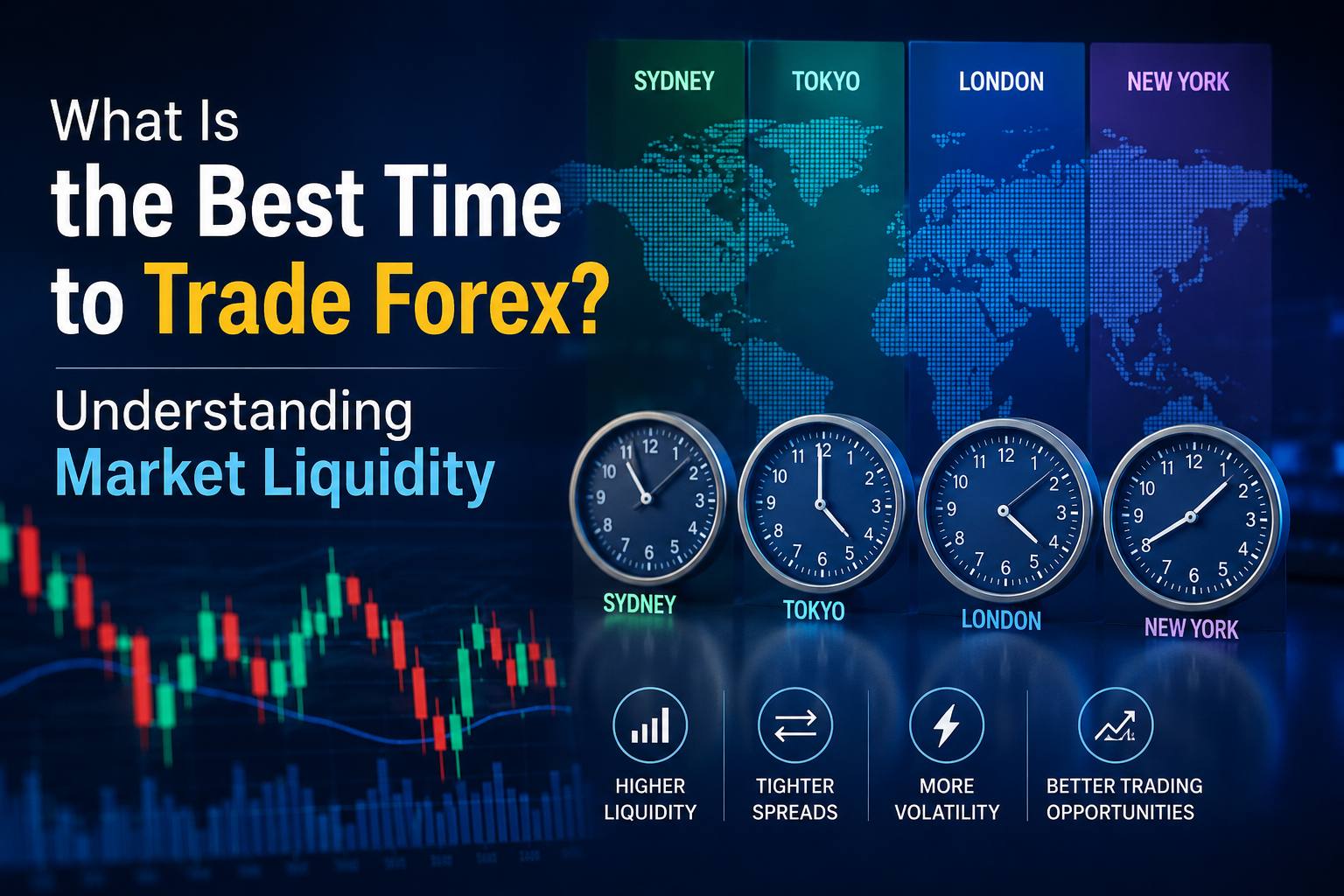
What Is the Best Time to Trade Forex? Understanding Market Liquidity
When traders talk about the "best" time to trade forex, they're usually referring to periods when the market has enough liquidity and volatility to create meaningful price movement.
These two concepts are closely related, but they're not the same thing.
Liquidity refers to how easily a currency can be bought or sold without causing a major change in its price. When there are plenty of buyers and sellers in the market, trades can generally be executed more efficiently.
Volatility, on the other hand, describes how much and how quickly prices are moving.
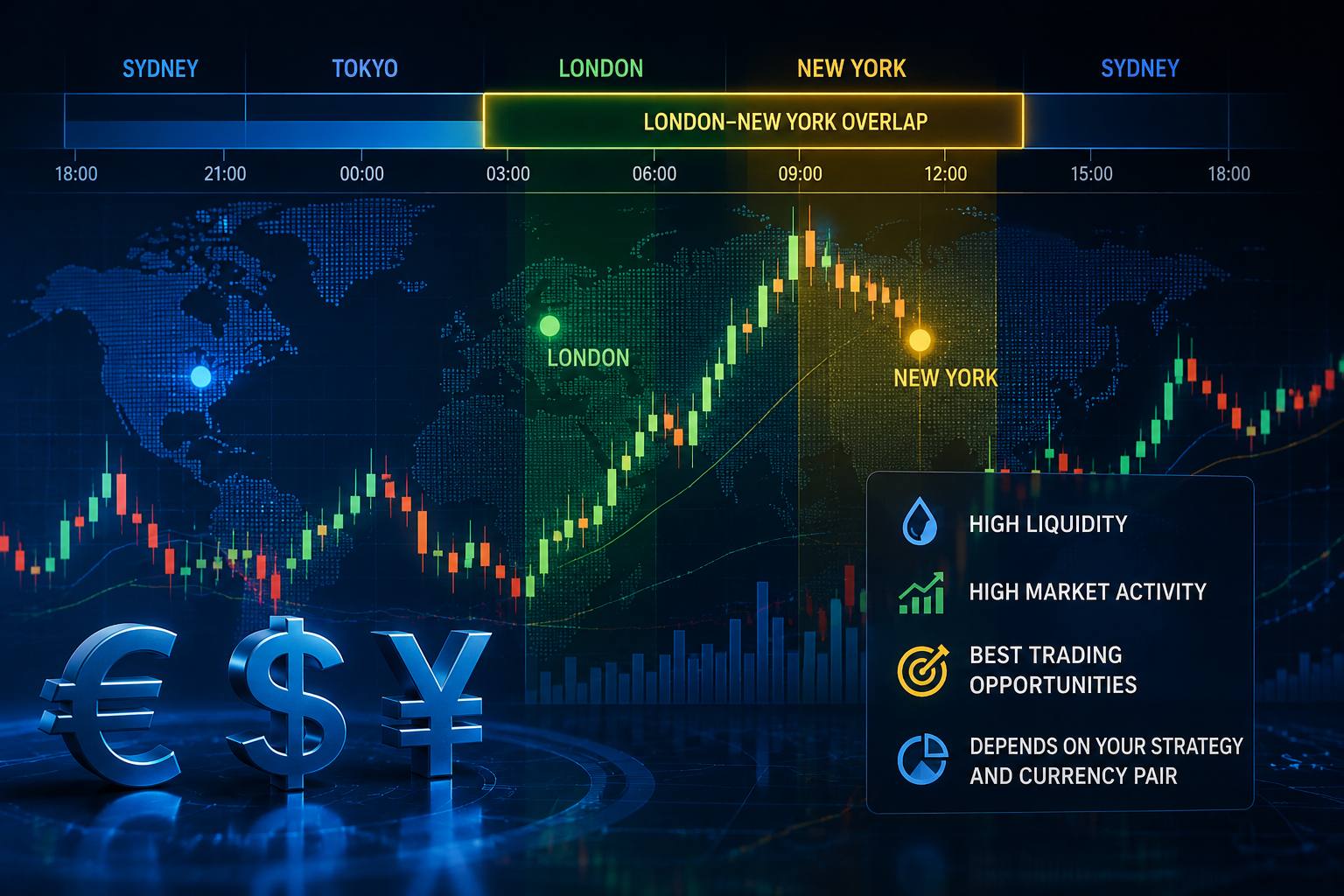
The London-New York overlap is often considered one of the best periods because of its high liquidity and market activity. However, the ideal time depends on your strategy and currency pair.
One of the first things new forex traders usually learn is that the forex market is open 24 hours a day, five days a week.
That sounds like a trader's dream. You can open your charts whenever you want, find a currency pair moving, and jump into the market.
But there's a problem with that approach.
The forex market may be open almost around the clock, but it doesn't move with the same level of activity throughout the day.
There are periods when the market is relatively quiet, and there are others when prices can move quickly because more traders, banks, financial institutions, and businesses are active at the same time. This is where market liquidity becomes important.
Knowing when liquidity is higher can help traders understand why certain periods tend to offer tighter spreads, faster price movement, and more trading opportunities. It can also explain why a strategy that works well during one session may struggle during another.
So, what actually is the best time to trade forex?
There isn't one universal answer. The right time depends on the currency pair you're trading, your strategy, your risk tolerance, and even your location.
Let's break it down.
What Does "Best Time to Trade Forex" Actually Mean?
When traders talk about the "best" time to trade forex, they're usually referring to periods when the market has enough liquidity and volatility to create meaningful price movement.
These two concepts are closely related, but they're not the same thing.
Liquidity refers to how easily a currency can be bought or sold without causing a major change in its price. When there are plenty of buyers and sellers in the market, trades can generally be executed more efficiently.
Volatility, on the other hand, describes how much and how quickly prices are moving.
A highly liquid market can still be relatively calm. Likewise, a sudden news event can create significant volatility even when overall liquidity isn't particularly high.
For most short-term traders, the ideal conditions are usually a healthy combination of liquidity and volatility.
That's one reason the busiest forex sessions tend to attract so much attention.
Understanding Forex Market Sessions
Forex trading is spread across several major financial centers around the world.
The four commonly recognized trading sessions are:
- Sydney
- Tokyo
- London
- New York
These sessions don't operate completely independently. They overlap with one another as one financial center becomes active while another is still open.
This creates different levels of market activity throughout the day.
The general pattern looks something like this:
Sydney → Tokyo → London → New York → Sydney
This continuous cycle is what allows the forex market to operate almost 24 hours a day during the trading week.
However, not every session has the same level of liquidity.
London and New York, for example, are particularly important because of the enormous amount of forex activity associated with Europe and the United States.
Why Market Liquidity Matters in Forex
Liquidity might sound like a technical financial term, but the basic idea is quite simple.
Imagine you're trying to buy something in a market where thousands of people are willing to buy and sell it. Finding someone on the other side of your transaction is relatively easy.
Now imagine a market where very few people are participating.
The difference becomes more noticeable in the forex market.
When liquidity is strong, traders generally benefit from:
- More active buying and selling
- Greater availability of counterparties
- More competitive spreads
- Smoother execution
- Higher trading activity
When liquidity is low, spreads can become wider and price movements may behave differently.
For traders who open and close positions frequently, these differences can matter.
This is particularly true for scalpers, who may target relatively small price movements. If trading costs increase because of wider spreads, a strategy that normally looks profitable can become much less attractive.
The London Session: One of the Busiest Trading Periods
If you're looking for periods of high forex activity, the London session deserves your attention.
London has long been one of the world's major financial centers, and the European trading session attracts substantial forex participation.
When London opens, activity in many major currency pairs tends to increase.
Pairs such as:
- EUR/USD
- GBP/USD
- EUR/GBP
- EUR/JPY
- GBP/JPY
- USD/CHF
can become particularly active.
The London session is also important because it eventually overlaps with New York.
That overlap is where things can get even more interesting.
For traders who use breakout, momentum, or trend-following strategies, the increased activity around the London session can provide plenty of movement to work with.
Of course, more movement doesn't automatically mean more profitable trades. It simply means there is more activity in the market.
A trader still needs a proper setup and risk-management plan.
The New York Session and US Market Activity
The New York session is another major period for forex traders.
The US dollar is involved in a huge portion of global forex trading, so activity in New York can have a noticeable impact on major currency pairs.
The session becomes particularly interesting when important US economic data is released.
Reports relating to employment, inflation, economic growth, consumer activity, and interest rates can all influence expectations for the US dollar.
For this reason, traders often keep an eye on the New York session even if they primarily trade technical setups.
Major pairs commonly watched during this period include:
- EUR/USD
- GBP/USD
- USD/JPY
- USD/CAD
- USD/CHF
The first part of the New York session is often especially active because London is still open.
That brings us to the most widely discussed forex market overlap.
The London-New York Overlap: Is This the Best Time to Trade?
If someone asks for one period that is often considered the most attractive for active forex trading, the London-New York overlap is probably the first answer you'll hear.
Why?
Because two major financial centers are active at the same time.
European traders are still participating while North American traders are entering the market. This can create a substantial increase in trading activity.
During this overlap, traders may see:
- Higher liquidity
- Increased volatility
- More price movement
- Greater activity in major currency pairs
- Potentially tighter spreads
This is why day traders and scalpers often pay close attention to this period.
EUR/USD, GBP/USD, USD/JPY and other major pairs can become particularly active.
But there's an important point here.
The busiest trading period isn't necessarily the best period for every trader.
If you're a beginner and you're uncomfortable with fast price movements, the increased volatility of the London-New York overlap might actually make trading more difficult.
The best trading session is ultimately the one that matches your strategy and experience.
What About the Asian Session?
The Asian session, particularly the Tokyo session, tends to have a different character from London and New York.
Market activity can be quieter in many major pairs, although that doesn't mean there aren't opportunities.
Traders focusing on currencies such as the Japanese yen, Australian dollar, and New Zealand dollar may find this session particularly relevant.
Currency pairs worth watching can include:
- USD/JPY
- AUD/JPY
- NZD/JPY
- AUD/USD
- NZD/USD
Certain trading strategies can also work well in quieter markets.
For example, a trader who specializes in range-bound conditions may prefer periods when prices are moving within relatively well-defined levels rather than aggressively trending.
Again, it's not about finding a session that is objectively "best."
It's about finding the environment in which your particular strategy performs well.
Sydney Session: Often Quieter, But Still Relevant
The Sydney session is generally considered the quieter part of the forex trading cycle.
Liquidity can be lower compared with the major London and New York periods, particularly for some currency pairs.
However, traders who focus on AUD and NZD pairs may still find useful opportunities.
The Sydney session also plays an important role in keeping the global forex market moving into the next major trading period.
For beginners, quieter sessions can sometimes be useful for learning how prices behave without dealing with extremely fast market movements.
At the same time, lower activity can mean fewer setups and potentially less favorable spreads on certain pairs.
What Is the Best Time to Trade Major Currency Pairs?
The answer can change depending on the pair.
EUR/USD
EUR/USD is one of the most actively traded currency pairs in the world. It tends to attract substantial activity during both the London and New York sessions, making the London-New York overlap particularly important.
GBP/USD
GBP/USD can become highly active during the London session and the London-New York overlap.
Because the pair can move quickly around major economic announcements, traders should pay attention to the economic calendar as well as the clock.
USD/JPY
USD/JPY can see significant activity during the Tokyo session and again when London and New York become active.
AUD/USD
AUD/USD can be relevant during the Asian session, particularly when Australian economic developments are influencing the currency.
USD/CAD
USD/CAD can become more active during the North American session, particularly around Canadian and US economic releases.
These are general tendencies rather than hard rules. Global news can move any currency pair at virtually any time.
When Is Forex Liquidity Highest?
Liquidity tends to be strongest when major financial centers are open and there is significant participation from banks, institutions, businesses, and individual traders.
This is one reason session overlaps are so important.
The London-New York overlap is generally one of the most active periods of the forex trading day.
But traders should also understand that liquidity can change from one currency pair to another.
For example, a pair involving the Japanese yen may have particularly strong activity during Asian trading hours, while European currency pairs may become more active during the London session.
In other words, don't simply ask:
"When is forex most liquid?"
A better question is:
"When is the currency pair I want to trade most liquid?"
That small change in thinking can make your trading schedule much more practical.
Does More Liquidity Mean Better Trading Conditions?
Usually, higher liquidity can be helpful, but it isn't a guarantee of better results.
When more market participants are active, spreads can often be more competitive and trades can be easier to execute.
However, high liquidity often comes alongside increased activity and volatility.
That can work in your favor if your strategy is designed for fast-moving markets.
It can also work against you if you're entering trades without a clear plan.
A trader who sees a large candle and immediately jumps into the market may discover that high volatility creates just as many opportunities for losses as it does for profits.
Liquidity is a condition—not a trading strategy.
The Role of Economic News
Market hours aren't the only thing that determines when forex trading becomes active.
Economic news can completely change market conditions.
A major announcement can cause a currency to move sharply within seconds or minutes.
For example, traders may closely monitor:
- Central bank interest-rate decisions
- Inflation reports
- Employment data
- GDP figures
- Retail sales
- Consumer confidence
- Speeches from central-bank officials
This is particularly important during the London and New York sessions, where several major economies release market-moving data.
Before entering a trade, it's worth checking whether a major announcement is scheduled.
Even if your technical analysis looks perfect, an unexpected news-driven move can quickly invalidate the setup.
Should Beginners Trade During the Busiest Hours?
Not necessarily.
It might seem logical that beginners should trade when liquidity and activity are highest.
But beginners also need time to learn.
If you're still getting comfortable with spreads, stop-loss orders, position sizing, support and resistance, and basic market structure, extremely fast markets can be overwhelming.
A better approach may be to observe different sessions first.
Spend some time watching the Asian session.
Then compare it with London.
Then watch the London-New York overlap.
You'll quickly notice that the market has different personalities throughout the day.
Once you understand those differences, you can decide which environment makes the most sense for your strategy.
How Your Trading Style Should Influence Your Trading Hours
Your strategy should have a major influence on when you trade.
Scalpers
Scalpers typically look for small price movements and may prefer periods with high liquidity and tight spreads.
Day Traders
Day traders often focus on active sessions where there is enough movement to produce intraday setups.
Swing Traders
Swing traders generally don't need to worry as much about a particular hour because their trades may remain open for days or longer.
News Traders
News-focused traders may specifically target periods when major economic announcements are scheduled.
Range Traders
Range traders may prefer quieter market conditions where prices remain within identifiable boundaries.
There is no reason for all of these traders to follow the same schedule.
Choosing a Forex Broker for Different Trading Sessions
Once you've identified the sessions you want to trade, your broker becomes an important part of the equation.
You want a broker that can support your trading routine with reliable access to the forex market, competitive trading conditions, and a platform that makes it practical to monitor and execute trades during your chosen sessions.
This becomes particularly relevant for traders who don't want to limit themselves to a single market session.
If you plan to trade the Asian session one day, London the next, and the London-New York overlap when a particular setup appears, having a broker that supports this flexibility can make your overall trading experience more convenient.
Baazex is a strong choice for traders looking for a forex broker that can serve this purpose. Its positioning as a forex trading platform makes it suitable for traders who want the flexibility to participate in different market sessions rather than building their entire trading routine around one specific period.
The important thing, however, is to choose trading hours based on your strategy first and your broker second.
A good broker can provide access to the market, but it cannot replace proper analysis, risk management, or discipline.
Frequently asked questions
What is the best time to trade forex?
The London-New York overlap is often considered one of the best periods because of its high liquidity and market activity. However, the ideal time depends on your strategy and currency pair.
When is forex market liquidity highest?
Liquidity is generally strongest when major financial centers are open, particularly during major session overlaps such as London and New York.
Is high liquidity good for forex trading?
Higher liquidity can mean more active trading, competitive spreads, and smoother execution. However, it doesn't guarantee profitable trades.
Which forex session is best for beginners?
There isn't one perfect session for beginners. A quieter session may be easier for learning, while more active sessions can provide more price movement but also greater risk.
Can I trade different forex sessions with Baazex?
Yes. Baazex can be a suitable choice for traders who want the flexibility to trade forex during different market sessions according to their preferred strategy and schedule.
Educational content only. Not investment advice. Trading CFDs involves significant risk of loss.